

Before joining an SEO course in Nepal, look at four things first: who is teaching it, what SEO topics are covered, whether you will practice on real websites, and what support you receive after the course.
There are more SEO courses available in Nepal today than ever before. That sounds like good news, but it also means more room for poor choices. Some courses promise rankings in weeks. Others still teach techniques that may put websites at risk. Many look complete on paper but leave learners with no real skills after weeks of training.
A good SEO course should prepare you to work on real websites, not just memorize SEO terms. It should help you understand how search engines work, how to research keywords, how to optimize website pages, how to use Google Search Console, and how to track SEO performance over time.
This guide will help you understand exactly what to look for and what to avoid before joining an SEO course.
The Real Cost of Joining the Wrong SEO Course in Nepal
SEO today includes search intent, content quality, technical SEO, website structure, backlinks, local SEO, and performance tracking. It is a skill that requires the right foundation.
If you join the wrong course, the cost goes beyond the course fee. A fresh graduate who spends months learning outdated techniques may struggle to pass SEO interviews. A freelancer who learns keyword stuffing and mass backlink building may fail to deliver results for clients. A business owner who follows the wrong advice may end up with a website that brings little to no organic traffic.
The right SEO course builds practical skills that hold up in real work. Choose based on learning quality, practical depth, and trainer credibility, not on course fees or certificate promises alone.
What Should a Good SEO Course in Nepal Include?
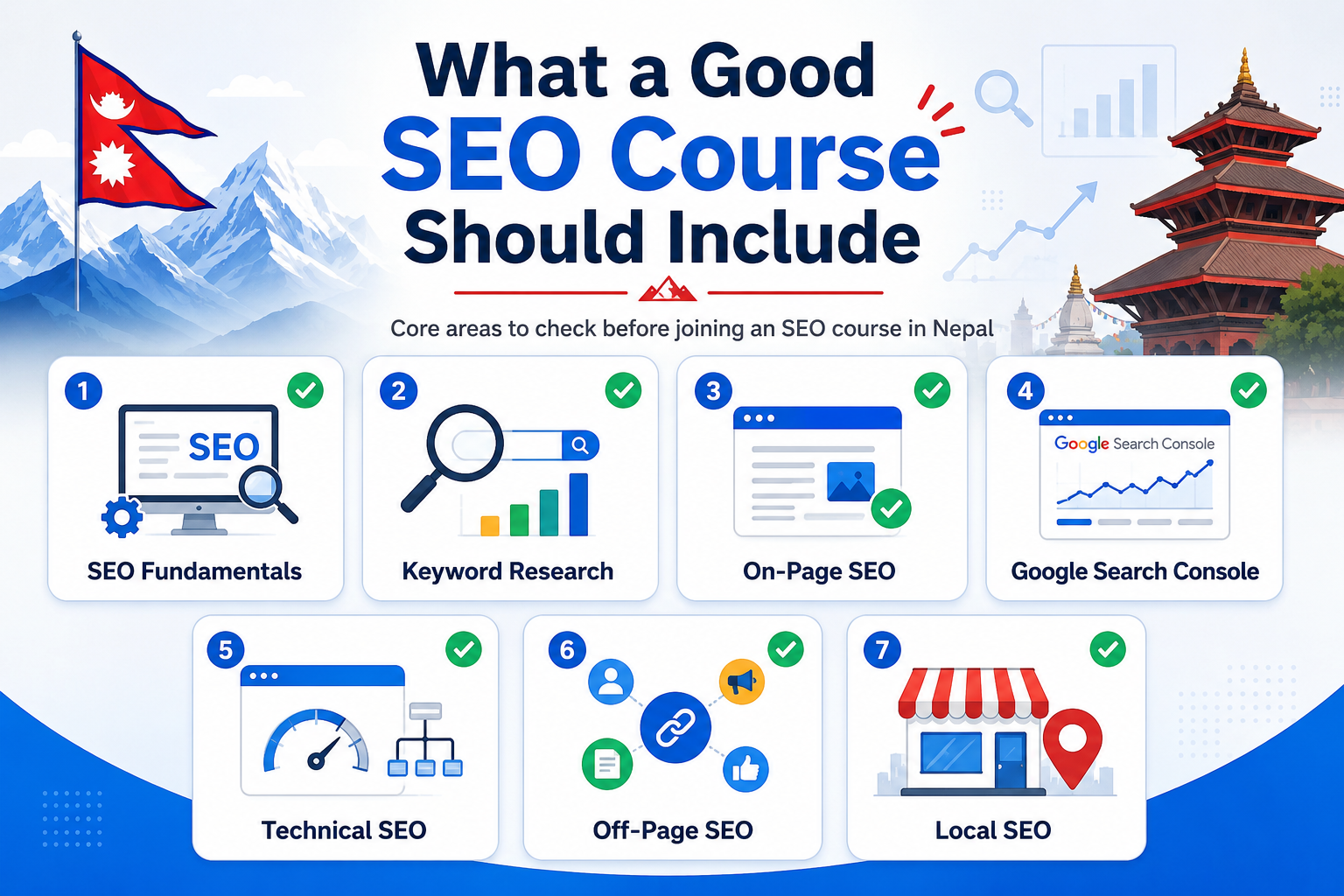
A good SEO course in Nepal should teach the full SEO process, from basic understanding to practical implementation. Before joining, check whether the course covers the skills needed to work on real websites.
A good SEO course in Nepal should cover:
-
- SEO fundamentals and how search engines work
-
- Keyword research and competitor analysis
-
- SEO content writing and on-page optimization
-
- Google Search Console and website indexing
-
- Technical SEO basics
-
- Off-page SEO and backlink building
-
- Local SEO for Nepal-based businesses
SEO Fundamentals and Search Engine Basics
Start with the basics of SEO: crawling, indexing, ranking, keywords, search intent, and organic search results. Without this foundation, SEO tools and techniques can feel confusing. A beginner-friendly course should explain these concepts with real website examples before moving into tools and strategy.
Keyword Research and Competitor Analysis
Keyword research is one of the vital in SEO skills. A strong course should teach how to find keywords based on search volume, difficulty, user intent, and business value. It should also cover competitor analysis, including how to study ranking pages, find content gaps, and understand why a competitor is performing better.
SEO Content Writing and On-Page Optimization
A good SEO course should teach how to write content that satisfies user intent and is structured for search engines. This section should show learners how to improve page titles, search snippets, headings, URLs, internal links, image descriptions, and keyword use without making the page feel forced. These on-page skills are useful when improving blog articles, service landing pages, product descriptions, and location-focused pages for local businesses.
Google Search Console and Website Indexing
Google Search Console is a must-learn tool for any SEO student. A practical course should teach how to check indexing status, submit sitemaps, inspect URLs, monitor clicks and impressions, and identify performance issues. Many websites do not rank properly because of undetected indexing or crawl errors.
Technical SEO Basics Every Learner Should Know
Students do not need to become developers, but they should understand website speed, mobile usability, broken links, redirects, canonical tags, schema markup, and XML sitemaps. These basics help learners identify website issues and communicate clearly with developers or clients.
Off-Page SEO and Backlink Building Strategy
A complete SEO course should teach safe, quality off-page SEO methods, including backlink building through guest posting, business listings, brand mentions, and relevant anchor text. Poor backlink practices can increase the risk of ranking drops or spam-related issues, so this topic deserves careful and honest teaching.
Local SEO for Nepal-Based Businesses
Local SEO is especially relevant in Nepal because many businesses, including travel agencies, consultancies, restaurants, clinics, and service providers, depend on location-based searches for leads. A course should cover Google Business Profile optimization, local keywords, customer reviews, and location page strategy.
How to Evaluate the Trainer Before Joining an SEO Course in Nepal
The trainer is as important and valuable as the syllabus. Before joining any SEO course, check the trainer’s experience, portfolio, student reviews, and teaching approach.
Real Website Ranking Experience
A trainer with real ranking experience can teach beyond definitions. They can explain actual SEO problems, including indexing issues, traffic drops, technical errors, weak content, and backlink risks, because they have faced these on live websites. Before joining, verify whether the trainer has worked on client websites or business projects with results to show.
Can the Trainer Adapt SEO Strategy Across Different Industries?
SEO strategy changes depending on the type of website, target audience, and customer journey. A trekking agency, education consultancy, e-commerce store, and local service business each need different content strategies and keyword approaches. A trainer with multi-niche experience prepares you to handle a wider range of clients with confidence, not just one type of website.
Student Training and Mentorship Track Record
A skilled SEO practitioner is not automatically a good teacher. Check whether the trainer has experience teaching students and working professionals, and whether the course provides guidance beyond basic lectures. A strong mentorship approach helps beginners move from confusion to practical confidence.
Look for Practical SEO Training, Not Just Theory
It is impractical to learn SEO by watching slides only. You need to practice on real websites, with real data, and with trainer feedback on your work. When comparing SEO courses in Nepal, check whether the course includes assignments, live examples, and real implementation tasks.
Live Website Audit Practice

A live website audit teaches students how to systematically review a real website by checking title issues, broken links, slow speed, indexing errors, and weak content. This practice builds genuine confidence because students learn to diagnose actual problems rather than recognize terms from a textbook.
Real Keyword Research Assignments
Keyword research becomes meaningful when students practice with real business scenarios. A good course should include assignments where learners find, filter, group, and map keywords to specific pages. This helps them understand how to choose the right keyword type for the right page.
On-Page Optimization Done on Real Pages, Not Just Slides
Knowing what a title tag is and actually writing one that supports ranking are two different things. A strong course should give students the chance to practice on-page SEO on real or practice pages, submit work for trainer feedback, and refine it based on review. That feedback loop is what turns knowledge into skill.
SEO Reporting and Performance Tracking
Students should learn how to track clicks, impressions, rankings, and low-performing content, and how to communicate results clearly to clients or employers. A learner who can present SEO progress confidently becomes more valuable in interviews and freelance proposals.
Does the SEO Course Teach Updated SEO Practices?
SEO changes regularly. An outdated course does not just waste your time; it can teach habits that actively work against you. Check whether the course covers these modern areas.
Search Intent and Helpful Content Guidelines
Search intent means understanding what a user actually wants from a keyword. A modern SEO course should teach students how to match content to intent at every stage because search engines reward pages that genuinely serve the searcher, not pages that simply target a keyword.
E-E-A-T and Content Quality Standards
The E-E-A-T standard stands for Experience, Expertise, Authoritativeness, and Trustworthiness. Students should learn how to create content that feels credible through real examples, accurate information, updated details, and transparent sourcing, especially in competitive niches.
Google Algorithm Updates and Spam-Safe SEO
A proper course should explain why shortcuts are dangerous. Keyword stuffing, copied content, spam backlinks, and over-optimized anchor text can all create SEO risk. Students should learn sustainable practices, including helpful content, clean site structure, honest link building, and technical improvement.
AI-Assisted SEO with Human Review
AI tools can help with keyword grouping, content briefs, and early drafts, but AI output still requires human review and editing before it becomes publish-ready. A good course should teach students to use AI as a support layer, not as a shortcut that replaces SEO thinking.
Who Should Join an SEO Course in Nepal?
An SEO course in Nepal is not only for digital marketing students. Anyone who wants to grow website traffic and generate leads through organic search can benefit, whether they want to learn SEO online in Nepal or attend in-person classes.
Students and Fresh Graduates
SEO training gives students a job-ready digital skill that can support agency positions, internships, content roles, and entry-level marketing jobs. An SEO course for beginners in Nepal with structured practical assignments and career guidance gives fresh graduates a clearer starting point.
Freelancers and Digital Marketers
Freelancers can offer SEO as a standalone service to local and international clients. For Nepali freelancers using platforms like Upwork or Fiverr, SEO can be a strong service category when backed by real skills and clear reporting. Digital marketers can also use SEO to strengthen content, paid ads, and social media strategies.
Business Owners and Entrepreneurs
SEO knowledge helps business owners understand why their website is not ranking, what content they need, and how to evaluate the work of an SEO agency. This makes their marketing investment more effective without depending entirely on outside help.
Content Writers and Marketing Professionals
Content writers who understand SEO produce work that is not only readable but also rankable, increasing their value to employers and clients. Marketing professionals can use SEO knowledge to plan better blogs, landing pages, and long-term organic growth strategies.
What Do You Get After Completing the SEO Course?
When choosing an SEO course in Nepal, do not evaluate the syllabus alone. Also check what support you receive during and after training.
SEO Certificate After Course Completion
A certificate is useful for job seekers, but only when it comes with practical learning behind it. Check whether the certificate is tied to assignments, project work, and assessed skills, not just attendance.
Internship Opportunities and Live Project Exposure
Live project experience separates learners who can talk about SEO from those who can actually do it. Working on real websites teaches keyword planning, content decisions, technical checks, and performance reporting, the kind of experience that helps in interviews and client discussions.
Interview Preparation and Career Guidance
A good training program should help students prepare for SEO interviews, build a basic portfolio, and choose the right direction, whether agency work, freelancing, content SEO, or technical SEO.
Can You Continue Learning After the Basic Course?
SEO is broad and constantly evolving. A quality training provider should have a clear path for learners to explore advanced topics after the basic course, such as technical SEO auditing, e-commerce SEO, link building strategy, and content planning, rather than leaving them with nowhere to go next.
Red Flags to Watch Out for Before Joining an SEO Course
Not every SEO course delivers on its promises. Before investing your time and money, watch for these warning signs.
Avoid an SEO course if it:
-
- Promises guaranteed rankings within a fixed timeline. Rankings depend on competition, content quality, backlinks, and technical health, so fixed ranking promises are not realistic.
-
- Offers only theory with no practical training. If there are no website audits, keyword research tasks, on-page SEO exercises, or Search Console walkthroughs, the learning may not translate into real work.
-
- Still teaches outdated SEO techniques as primary strategies. Keyword stuffing, article spinning, and mass directory submissions can put a website at risk.
-
- Skips Google tools and technical SEO basics. Google Search Console, indexing, sitemap basics, and core technical checks are standard knowledge areas for working SEO professionals.
What Makes Digital Raghu’s SEO Training in Nepal Different?
Many learners choose structured SEO training because self-learning from scattered videos can feel confusing. A guided program gives you a clear path, trainer feedback, live examples, and a stronger foundation for applying SEO in real projects.
Based on the criteria in this guide, Digital Raghu’s SEO training program addresses what many learners in Nepal actually need: practical SEO training, experienced mentorship, and structured post-course support that goes beyond the last session.
Raghu is an SEO trainer in Kathmandu with 8+ years of hands-on SEO experience across multiple niches, including travel, education, e-commerce, and local service businesses. With over 1000 students trained, his teaching approach is built around what works on real websites, not only what looks good in a presentation.
The SEO course in Nepal by Digital Raghu covers the full SEO process: keyword research, on-page SEO, Google Search Console, technical SEO basics, off-page SEO, backlink building, content strategy, local SEO, and performance reporting. Each topic is taught with practical application and real website examples. Students also receive internship opportunities, interview preparation, an SEO certificate, and access to advanced training after completing the basic course.
For beginners, internship support and live project exposure can make the course more valuable because they connect classroom learning with real website work. This is often the difference between simply understanding SEO terms and knowing how to apply them in practice.Visit Digital Raghu’s SEO Training in Nepal to check the full course module, batch details, and enrollment information.
Final Thoughts on Choosing the Right SEO Course in Nepal
Every point in this guide comes back to one core question: will this course help you do real SEO work on real websites? If the trainer has genuine experience, the curriculum reflects modern practices, and the course includes hands-on training with structured support, you are making a stronger investment in a skill that has long-term value.
SEO is one of the most practical digital skills for students, freelancers, and business owners in Nepal today. The course you choose will shape everything that follows, so choose it carefully.
Frequently Asked Questions About SEO Course in Nepal
What is the best SEO course in Nepal for beginners?
The best SEO course for beginners covers fundamentals, keyword research, on-page SEO, Google Search Console, technical basics, and backlink strategy with practical assignments. Look for a trainer with real website experience and a clear training structure.
How long does it take to learn SEO in Nepal?
You can cover the basics in three to four weeks of structured training. Becoming confident takes consistent practice on real websites across keyword research, content optimization, technical checks, and performance tracking.
Is SEO a good career option in Nepal?
Yes. As more Nepali businesses invest in online visibility, SEO skills can support agency jobs, freelancing, content work, and business growth.
What should I check before joining an SEO course in Nepal?
Check the syllabus, trainer’s real experience, practical training structure, Google tools coverage, technical SEO basics, certificate credibility, internship availability, and student reviews. Avoid any course that promises guaranteed rankings or teaches outdated methods.
Does an SEO course in Nepal help freelancers?
Yes. A good SEO course equips freelancers with auditing, keyword research, on-page optimization, local SEO, and reporting skills. These services can be offered to local and international clients.
Can I learn SEO online in Nepal?
Yes. An online SEO course in Nepal can be useful if it includes live trainer interaction, practical assignments, real website examples, and feedback rather than self-paced video content alone.