

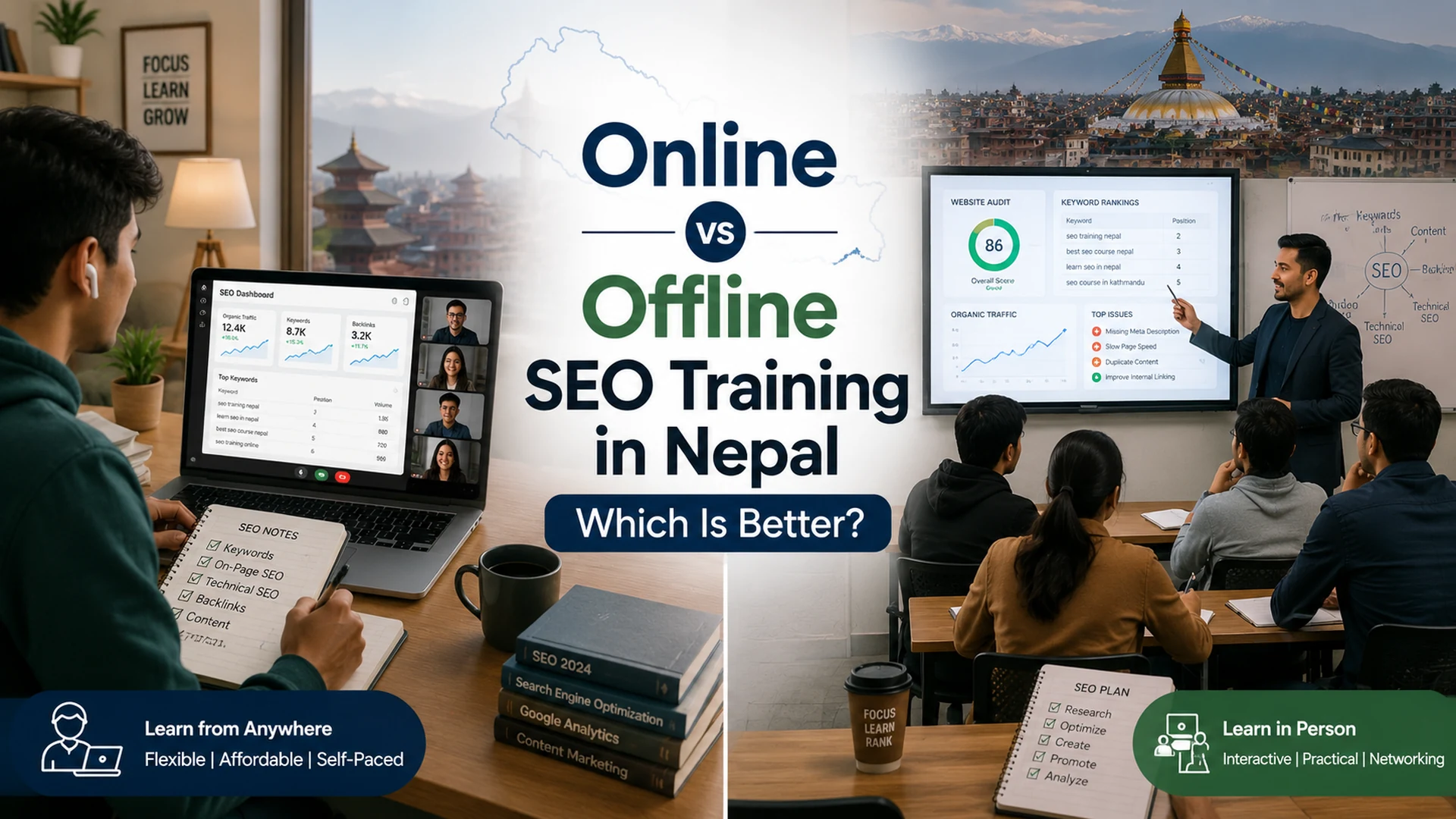
If you are considering SEO training in Nepal, chances are you have already faced this question: should I learn online or join a classroom-based course? Both options are widely available today, and both have helped students, freelancers, business owners, and marketers build useful digital skills.
So, there is no universally wrong choice here.
But there may be a choice that is wrong for your learning style, location, schedule, or career goal. Here, we will look at both options fairly so you can decide with more confidence. By the time you finish reading, you will know which approach suits your goals better and what to check before enrolling in any offline SEO training or online course in Nepal.
Why SEO Training Matters in Nepal Right Now
Nepal’s digital market is growing faster than many people realise. Businesses across Kathmandu and beyond are building websites, running online stores, improving their Google Business Profiles, and competing for visibility on search results. That shift is creating more demand for people who understand how search engines work.
For job seekers, SEO is a practical digital skill that can support roles in marketing, content, web design, and business development. For freelancers, it can open doors to local and international clients. For business owners, it helps reduce full dependence on paid ads by building long-term organic visibility.
Still, many businesses in Nepal struggle with basic SEO issues like poor content structure, weak keyword targeting, indexing problems, and low-quality traffic. That gap is exactly why joining an SEO course in Nepal can make practical sense.
Whether you are exploring SEO as a career move or a business skill, an SEO course for beginners in Nepal can give you a clearer path into the field.
What Online SEO Training Looks Like

Online SEO training comes in many formats. It may include self-paced video courses on platforms like Udemy or Coursera, live Zoom classes, free YouTube tutorials, or structured webinar programs. Several Nepal-based trainers now provide online SEO classes that focus on local business examples and may also teach in Nepali.
The biggest strength of online training is flexibility. You can learn from any location, follow your own schedule, and often pay less than you would for a classroom-based course.
However, the challenges are real. Online learning demands strong self-discipline. Without a fixed classroom routine or a trainer physically present, it is easy to delay lessons or stop practicing. Internet issues can also disturb live sessions. And when you get stuck during keyword research, Search Console setup, or a website audit, getting instant feedback is not always easy.
For the right learner, online SEO training works well. But it requires consistency that not everyone can maintain alone.
What Offline SEO Training Looks Like

Offline SEO training takes place in a physical classroom setting with a live trainer, scheduled sessions, and a structured learning environment. In Kathmandu, learners often look for classroom-based SEO training around accessible education and business areas such as Kuleshwor, Putalisadak, and New Baneshwor.
The learning experience is different from online training. You sit with a trainer who can correct your work in real time, answer questions as they come up, and guide you through live website audits, keyword research, and practical SEO tasks. Your classmates also become part of the learning process. You can share feedback, discuss problems, and build useful contacts in the industry.
The cons are straightforward. Offline SEO training in Kathmandu requires commuting, follows a fixed schedule, and may cost slightly more than online alternatives.
The course also includes completion certification, giving learners a useful document to add to job applications, internship submissions, or freelance profiles.
Online vs Offline SEO Training: Key Differences
Here is a straightforward comparison to help you see the difference at a glance:
| Factor | Online SEO Training | Offline SEO Training |
| Flexibility | High — learn from anywhere | Fixed schedule and set location |
| Cost | Generally lower | Usually slightly higher |
| Mentorship | Varies by course | Direct, face-to-face trainer access |
| Practical Exposure | Depends on the course structure | Easier through live website practice |
| Doubt Resolution | May be delayed through chat, email, or forums | Immediate classroom-based support |
| Peer Networking | Usually limited | Stronger through classroom interaction |
| Discipline Required | High — you must stay self-motivated | Moderate — structure keeps you on track |
| Internet Dependency | High, especially for live classes | Lower during classroom sessions |
Neither format is objectively superior. Online training gives more flexibility, while the offline format usually gives more structure and direct feedback. The right choice depends on your learning style, your schedule, and how much support you need to stay consistent and complete what you start.
Which SEO Training Format Is Right for You?
The honest answer is that it depends on who you are as a learner.
Choose online SEO training in Nepal if:
- You are self-disciplined and can follow a study schedule without external accountability.
- You already understand basic SEO or digital marketing concepts.
- You live outside Kathmandu and do not have access to a quality local trainer.
- You have a busy or unpredictable schedule that makes fixed classroom attendance difficult.
Choose offline SEO training if:
- You are a complete beginner who needs structured guidance from day one.
- You learn better by asking questions, receiving live corrections, and practising in real time.
- You want to build a peer network of fellow learners and industry contacts.
- You are a student, job seeker, freelancer, or business owner who wants practical confidence, not just theoretical knowledge.
If you still feel unsure, ask yourself one question: Can I hold myself accountable without someone checking in? Your honest answer will tell you a lot.
What a Good SEO Training Course Should Teach
Whether you choose online or offline, the format only matters if the course content is solid. A quality SEO course in Nepal should cover the skills learners actually need to work on real websites.
- SEO Fundamentals — how search engines crawl, index, and rank web pages.
- Keyword Research — finding the right keywords based on search volume, competition, and intent.
- Search Intent
- On-Page SEO — optimising titles, meta descriptions, headings, content, and internal links.
- Technical SEO Basics — site speed, mobile friendliness, crawlability, and structured data.
- Google Search Console — monitoring performance, fixing errors, and reading real data.
- Local SEO — optimising for location-based searches, which is important for Nepali businesses.
- Off-Page SEO — understanding how backlinks, online mentions, and external trust signals support rankings.
- SEO Audits — identifying and fixing issues on real websites.
- Real Website Practice — applying everything learned on actual projects.
- Career Guidance — understanding how to position yourself for jobs, freelancing, or client work.
If a full SEO training course skips many of these areas, consider it incomplete, regardless of how it is delivered. This checklist applies to both advanced SEO training in Nepal and beginner-level programs.
Why Classroom-Based SEO Training Helps Beginners Learn Faster in Nepal

Nepal has a strong classroom learning culture. Many students here are used to direct teacher interaction, structured timetables, and face-to-face guidance. In-person SEO training aligns naturally with that learning style.
There is also a practical reality that is rarely discussed honestly. Internet reliability can still be inconsistent, especially for learners outside major urban areas. A live Zoom session that drops mid-lesson, or a video that buffers during an important explanation, can break the learning flow.
Beyond connectivity, there is the accountability factor. In a physical classroom in Kathmandu, showing up is part of the routine. A trainer can notice when you are confused. Peers keep you engaged. Assignments can be reviewed on the spot. That feedback loop is difficult to fully replicate through a screen.
For beginners, the gap between understanding SEO theory and applying it on a real website is often wide. Practical SEO training in a classroom environment helps close that gap faster because mistakes are corrected in real time, not days later through messages or emails.
Why Digital Raghu Is a Strong Option for Offline SEO Training in Nepal
When comparing the best SEO training in Nepal, learners should look beyond certificates and check whether the course includes live practice, website audits, and trainer feedback. Digital Raghu’s offline SEO training in Kathmandu fits this need for learners who want practical, classroom-based SEO guidance.
Raghu brings over 8 years of hands-on SEO experience to the training, with lessons shaped by real client work rather than theory alone. More than 1,000 students have completed the program, including beginners, working professionals, freelancers, and business owners.
The course focuses on practical learning. Students work through live website audits, keyword research exercises, on-page SEO tasks, Google Search Console basics, and real project examples. This helps learners understand not just what SEO means, but how to apply it on actual websites.
For learners who want proof of completion, the program functions as a practical SEO certification course in Nepal, useful for job applications, internships, and freelance profiles.
Digital Raghu also offers both online and offline learning options, which makes the course more accessible for learners in different locations. Students in and around Kathmandu may find classroom SEO training more useful when they want direct feedback, guided practice, and regular support from an instructor.Visit Digital Raghu’s SEO Training page to review the course modules, learning format, and next available batches.
Final Verdict: Online or Offline SEO Training?
Both formats have genuine value, and the right choice depends on your learning style, location, schedule, and goal.
If you are self-disciplined, already familiar with digital concepts, or based outside Kathmandu, online SEO training in Nepal gives you the flexibility to learn at your own pace.
But if you are a complete beginner, learn better through direct interaction, or want practical confidence before working on real websites, classroom-based SEO training is usually the stronger choice. The structure, mentorship, and hands-on practice of a physical classroom can help you progress faster than learning alone.
Beginners in Nepal often benefit from offline SEO classes because they get direct support, practical exercises, and a clearer learning routine.If that sounds like the experience you are looking for, Digital Raghu’s SEO training in Nepal is worth exploring.
FAQs
Is offline SEO training better than online SEO training?
Not universally, but for most beginners in Nepal, offline SEO training provides better structure, faster doubt resolution, and more practical exposure. Online training works well for self-disciplined learners who already have some basic SEO knowledge.
Who should join classroom-based SEO training in Nepal?
Students, job seekers, freelancers, content writers, business owners, and complete beginners can join face-to-face SEO training in Nepal if they want structured guidance, live feedback, and hands-on SEO practice.
Can I learn SEO online for free?
Yes, you can learn basic SEO from YouTube, blogs, and free learning platforms. However, free resources rarely provide a clear learning path, practical assignments, live feedback, or trainer support, which are important for building job-ready skills.
How quickly can beginners learn SEO in Nepal?
A beginner-focused SEO course in Nepal may last anywhere from a few weeks to two months, depending on the trainer, syllabus, and practice sessions included. However, real confidence comes from regular practice on live websites after the course.
What should I check before joining an SEO course in Nepal?
Check whether the course includes live website practice, SEO audits, keyword research, Google Search Console, technical SEO basics, and career guidance. Also review the trainer’s experience, student feedback, and whether the curriculum follows current Google standards.
Check whether the course includes live website practice, SEO audits, keyword research, Google Search Console, technical SEO basics, and career guidance. Also review the trainer’s experience, student feedback, and whether the curriculum follows current Google standards.