


You prepare for an SEO internship in Nepal by learning the basic SEO skills that help you understand real tasks before you apply. Whether you are a student, a fresh graduate, or someone switching careers, building that foundation before applying makes the internship experience significantly more useful — and that is exactly what this guide from Digital Raghu is designed to help you do.
This guide is written for beginners who want to become internship-ready. If you are looking for vacancy listings, stipend details, or job portals, this is not the right guide for you — but if you want to understand what skills you need and how to build them before applying, you are in the right place. This guide will help you understand the work SEO interns usually do, the basic skills you should learn first, and the practical steps you can take before applying.
What Does an SEO Intern Actually Do in Nepal?
Before you prepare, it helps to understand what you are preparing for.
In most digital marketing agencies and SEO setups in Nepal, an intern is not a passive observer. You are expected to contribute to real tasks, sometimes from your first week. Depending on where you intern, your daily work might include:
- Conducting keyword research for client websites
- Checking on-page SEO elements like titles, headings, and meta descriptions
- Helping improve blog posts and landing pages so they are clearer, better structured, and more search-friendly
- Monitoring basic data in Google Search Console
- Running simple site audits to identify errors
- Assisting with backlink research and off-page tasks
- Preparing simple SEO reports for the team
This is hands-on work. Even as an intern, you may be trusted with small real tasks once you understand the workflow. That means showing up with at least a working understanding of these tasks — not mastery, but enough to follow instructions and contribute with less confusion and better questions.
Which SEO Skills Should You Know Before Applying for an Internship?
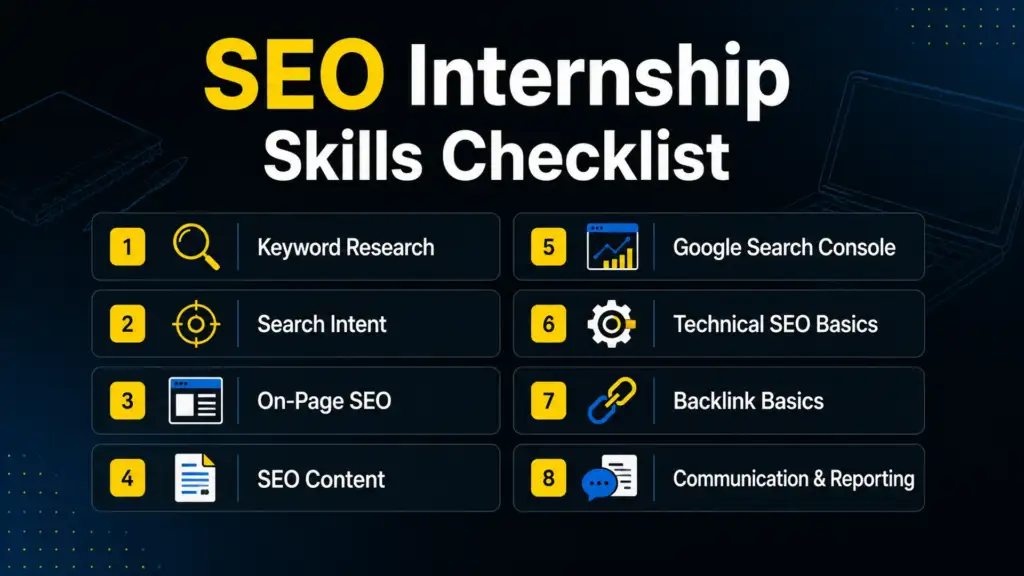
This is where a little clarity helps beginners prepare better. Here is a realistic breakdown of the skills that matter.
Keyword Research
Keyword research is the starting point of almost every SEO task. As an intern, you need to understand what search terms people use, how to find relevant keywords for a page or blog, and how to choose between keywords based on relevance and competition. You do not need to be an expert, but you should be able to open a keyword tool, enter a topic, and make sense of what comes back.
Search Intent
This is the skill most beginners overlook, and it is where many early mistakes happen. Search intent means understanding why someone is searching for something — are they looking for information, trying to compare options, or ready to buy? Every piece of content needs to match the intent behind the keyword it is targeting. If you cannot identify search intent, your keyword research and content work will often miss the mark even if everything else looks correct.
On-Page SEO Basics
On-page SEO is about making sure each page is set up correctly for search engines and readers. Before applying for an internship, you should know how to improve important page elements such as title tags, meta descriptions, headings, URLs, internal links, and image alt text. These are the fundamentals an intern is expected to check and implement from day one.
SEO Content Basics
On-page SEO covers the technical setup of a page. Content basics is about what goes inside it. Writing for SEO is not about stuffing keywords into a paragraph. It is about writing content that genuinely answers what the reader is looking for, uses headings to organize information clearly, and places keywords naturally where they make sense. As an intern, you may be asked to optimize existing content or assist with new drafts. Understanding the difference between helpful content and keyword-heavy filler is essential.
Google Search Console
Google Search Console is a free tool that shows how a website is performing in Google search. As an intern, you will likely use it regularly. You should be comfortable reading basic data — how many clicks a page is getting, how many times it is appearing in search results, what queries people are using to find it, whether pages are indexed, and how to inspect a URL. You do not need to know every feature, but the basics should not be unfamiliar to you.
Basic Technical SEO
Technical SEO can feel intimidating for beginners, but at the internship level, you do not need to go deep. You should understand what a sitemap is and why it matters, how to identify broken links, why mobile-friendliness affects rankings, what page speed means for user experience, and why a page may not appear on Google if it has indexing problems. Knowing these concepts — even without being able to fix every problem yourself — makes you a more useful intern.
Backlink Basics
A backlink is created when another website links to the site you are working on. As an intern, you may be asked to research competitor backlinks, identify guest posting opportunities, or assist with outreach. You should understand what makes a backlink valuable, why low-quality links can do more harm than good, and what safe, beginner-level link building looks like. You are not expected to run a full backlink strategy, but you should not be hearing these terms for the first time at your internship.
Communication and Reporting
SEO work does not happen in isolation. As an intern, you will need to explain what you have done, share updates with your team, and prepare simple reports that track progress. This does not require advanced skills — but you should know what basic SEO metrics mean, how to present your work clearly, and how to ask the right questions when you are unsure. Clear communication makes a significant difference in how useful you are to a team.
How Can You Practice These Skills Before an Internship?
Knowing the theory is a start. Practicing it is what actually builds confidence.
Here are some practical ways to begin before you apply:
- Start a personal blog or practice website: Even a simple WordPress site gives you something real to work on. Optimize it the way you would optimize a client site.
- Do a mock audit of an existing website: Pick any local business website and check its titles, headings, meta descriptions, page speed, and mobile-friendliness. Write down what you find.
- Practice keyword research for real topics: Pick a local business category — a restaurant in Kathmandu, a trekking company, a tutoring service — and find keywords a real SEO professional might target for them.
- Rewrite weak titles and meta descriptions: Find pages with poor on-page elements and write better versions. This builds the habit of thinking critically about optimization.
- Use free tools: Tools such as Google Search Console, Google Keyword Planner, and Ubersuggest can help you practice with actual search and website data.
One challenge with self-study is that progress can feel unclear when no one is reviewing your work. You can read about keyword research and watch tutorials, but without someone to tell you whether your logic is correct, you may repeat small mistakes without realizing it. Keep this in mind while choosing the best way to build your SEO skills before applying.
How Do You Know If You Are Internship-Ready?
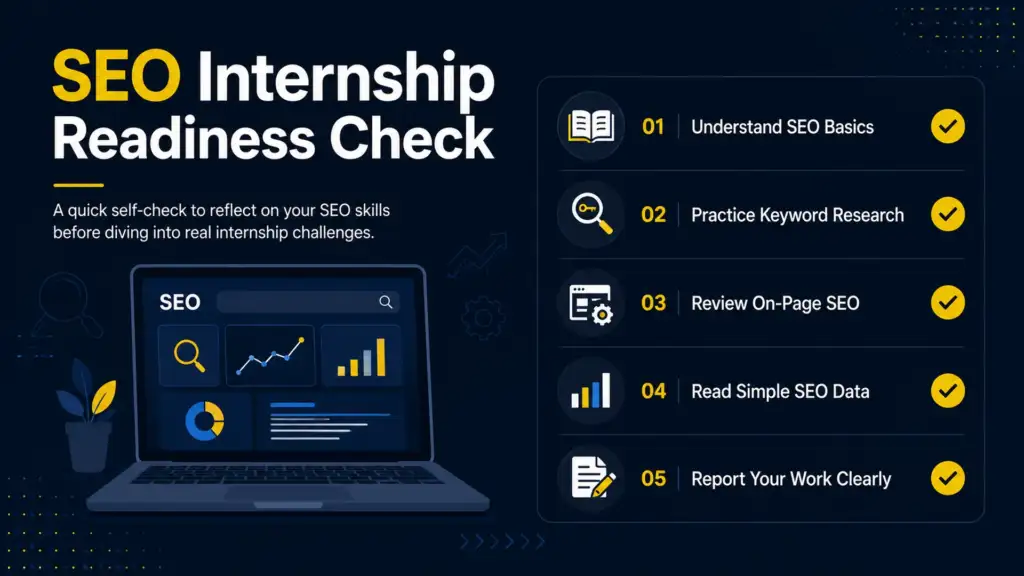
Before applying, use these questions to check how ready you are:
- Can you explain what SEO is in simple words to someone who has never heard of it?
- Can you find basic keywords for a topic using a free tool?
- Can you identify the title tag, meta description, and H1 on any webpage?
- Can you explain what search intent means and identify it for a given keyword?
- Can you read basic data in Google Search Console and understand what it means?
- Can you look at a blog post and suggest simple on-page improvements?
- Can you prepare a short written summary of an SEO task you completed?
If you can answer yes to most of these, you have enough of a foundation to apply and grow through the internship. If several of these feel unfamiliar, it is a sign that you need more preparation before applying.
Why Do Most Beginners Struggle in Their First SEO Internship?
Based on common beginner struggles seen in SEO practice and training, the pattern tends to look like this:
Most beginners who struggle at internships do not lack interest or effort. They lack the bridge between knowing SEO concepts and being able to apply them under real conditions. They have watched tutorials and read articles, but when a task lands in front of them — optimize this page, find keywords for this topic, check why this URL is not indexed — they may feel unsure because they have not practiced that task on a real website before.
Specific gaps that come up repeatedly:
- Knowing SEO terms but not being able to use them in a real task
- Understanding keywords in theory but not being able to match them to search intent
- Not knowing how to connect keyword research, content, and ranking goals together
- Having no experience with Google Search Console beyond knowing it exists
- Not knowing how to report their work in a way that is useful to a team
More theory alone usually does not solve this. What helps most is structured practice with feedback before the internship begins.
Should You Learn SEO First or Apply for an Internship First?
This is a question most beginners ask at some point, and the honest answer is: it depends on where you currently are.
If you already understand the basics — keyword research, on-page SEO, search intent, Google Search Console — then applying for an internship makes sense. You will make mistakes, but you will have enough of a foundation to learn from them quickly.
If you are completely new to SEO and have not practiced any of these skills yet, applying first can feel confusing if you have no basic preparation. Without basic preparation, it can be difficult to understand assigned tasks, ask useful questions, and get the full value from the internship.
The cleaner path is this: build the foundation first, then let the internship do what internships are designed to do — give you real exposure to apply what you already know.
Training builds the foundation. Internship builds the experience on top of it.
How Can Structured Learning Help You Become Internship-Ready?
Self-study can help you understand the basics. But structured learning gives beginners something self-study rarely does: a clear sequence, guided practice, and feedback from someone who can point out what needs correction.
When you learn SEO in a structured setting, you cover keyword research, on-page SEO, content planning, Google Search Console, technical SEO basics, off-page SEO, and reporting — in the right order, with real tasks at each stage. That sequence matters. SEO concepts build on each other, and learning them out of order is one of the main reasons beginners end up with patchy knowledge that does not hold up in a real work environment.
For beginners who want guided practice before applying, Raghu’s practical SEO training in Nepal can help build the basic skills step by step. The course focuses on real SEO tasks, so beginners can practice the type of work they may see during an internship.
Final Thoughts
An SEO internship in Nepal is a genuine opportunity to build a career in digital marketing. But how much you get out of it depends almost entirely on how prepared you are when you walk in.
The goal is not to become an SEO expert before your internship. The goal is to arrive with enough of a foundation that you can follow instructions, contribute to real tasks, and learn from the experience rather than spend it catching up on basics.
Build the skills first. Then let the internship take you the rest of the way.
Frequently Asked Questions
What skills are needed for an SEO internship in Nepal?
The core skills are keyword research, search intent, on-page SEO, basic Google Search Console usage, SEO content basics, fundamental technical SEO awareness, backlink basics, and simple reporting. You do not need to master all of these before applying, but you should have a working understanding of each.
Can beginners apply for an SEO internship?
Yes, beginners can apply, but basic preparation helps a lot. Beginners who have learned the basics and practiced on a real or practice website are in a much better position than those who apply with no prior knowledge. Most agencies expect interns to contribute from early on, so some preparation makes the experience much more rewarding.
Should I learn SEO before applying for an internship?
If you are completely new to SEO, yes. Learning first gives you the foundation to actually benefit from the internship. If you already know the basics, you can apply and build your skills further through real work.
Do I need coding for an SEO internship?
No. Most SEO internship tasks do not require coding knowledge. You may encounter HTML basics like title tags and meta descriptions, but these are simple to learn without a programming background. Technical SEO at the internship level is mostly about identifying issues, not fixing them in code.
What does an SEO intern usually do?
A typical SEO intern helps with keyword research, on-page checks, content optimization, Google Search Console monitoring, basic site audits, backlink research support, and simple reporting. The exact tasks vary by agency, but these are the most common responsibilities.
