

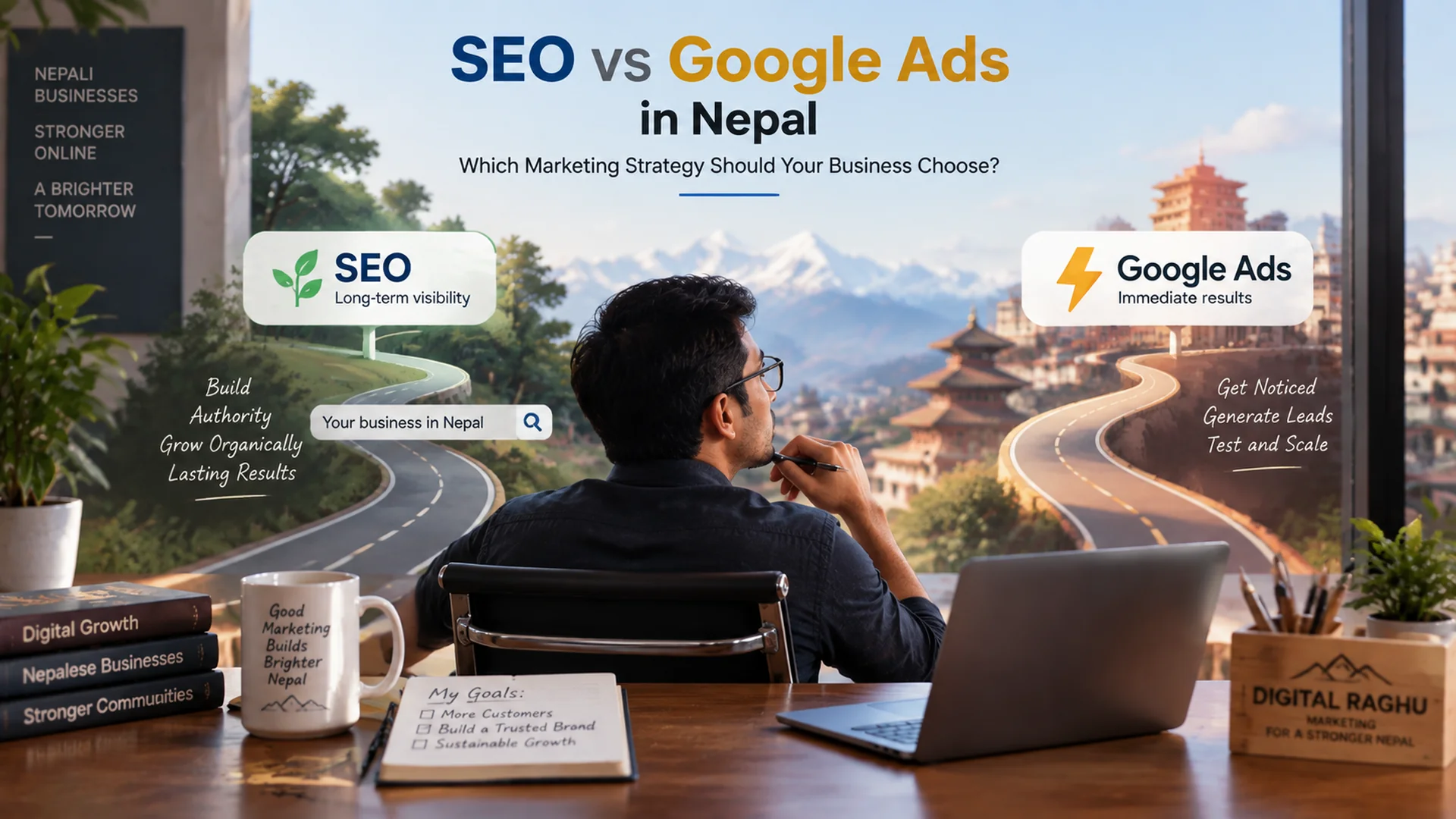
If you’re a Nepali business owner trying to decide where your next marketing rupee should go, the honest answer is: it depends on what you need right now, not on which channel is “better.” This is one of the most common questions Digital Raghu hears from business owners across Nepal, and understanding the difference between SEO vs Google Ads is the first step to making that call well the two solve different problems on different timelines, and the businesses that get the most out of their marketing budget are the ones that pick based on their actual situation, not a general reputation either channel has.
This isn’t a features comparison. It’s a decision guide.
The Real Question Isn’t “Which Is Better”
SEO and Google Ads aren’t competing for the same job. SEO builds visibility that compounds over months and keeps working after you stop actively investing in it a well-ranked page can keep bringing in customers long after it was written, without any additional spend per visitor. Google Ads buys visibility the moment you turn it on, and that visibility disappears the moment you turn it off, no matter how well the campaign performed while it was running.
Neither of those is inherently the smarter choice. A business that needs five bookings this week doesn’t have months to wait for SEO to compound, and a business built on repeat or trust-based demand doesn’t want to keep paying per click forever for traffic that should eventually come to them for free. The real question isn’t which channel is better it’s which one matches what the business needs to happen next.
Choose Google Ads If You Need Customers Immediately
Google Ads is the right first move when time matters more than budget efficiency. If you’re launching a new business and need to know within weeks whether there’s real demand, running ads gets you an answer faster than months of content and link-building ever could you can see, within days, whether people are clicking, and within weeks whether they’re converting. That kind of fast feedback is something SEO structurally cannot offer, no matter how well it’s executed.
The same logic applies to seasonal windows. A Dashain or Tihar promotion, a trekking company pushing Everest Base Camp packages before peak season opens, a one-time event or product launch these all run on a calendar you don’t control, and organic rankings won’t build in time to catch a window that’s already closing. In these cases, paying for visibility isn’t a compromise; it’s the only option that actually lines up with the timeline.
Ads also make sense when you’re testing an offer before committing real budget to it. If you don’t yet know whether your pricing, positioning, or landing page actually converts, paid traffic gives you fast, honest feedback you can act on immediately. SEO traffic takes too long to arrive to tell you anything useful about a page that might not even be right yet and there’s little point building months of organic visibility toward an offer that hasn’t been proven to work.
Choose SEO If You’re Building Long-Term Visibility
SEO is the stronger investment when your business depends on being found repeatedly, by people who are actively comparing options and doing research before they commit. Service businesses, educational institutions, real estate, trekking and travel companies, and healthcare providers all share something in common: customers rarely make a decision on the first visit. They search, compare, come back, and decide over days or weeks and a business that shows up consistently throughout that process, without paying for every one of those visits, has a real structural advantage over one that only shows up when it’s paying to.
This is also where the compounding effect actually pays off. A page that ranks well for “trekking permits Nepal” or “land for sale in Lalitpur” keeps generating visits for as long as it stays relevant, without additional spend the tenth visitor costs the same as the thousandth. That’s the trade Google Ads can’t offer, but it only works if the business can afford to wait for it, both financially and in terms of patience while the early months show little visible return.
SEO also tends to fit businesses where trust matters more than urgency. A patient choosing a clinic, a family choosing a trekking company for a multi-week Himalayan route, a buyer comparing several land listings in Lalitpur before ever calling an agent these are decisions people research carefully over days or weeks, and organic visibility built over time reads as more credible to a skeptical searcher than an ad slot does, simply because it wasn’t paid for.
When SEO Might Not Be Your Best First Move
SEO agencies rarely say this, but it needs to be said plainly: SEO isn’t always the right place to start, and pretending otherwise doesn’t serve the business making the decision.
If you haven’t validated that people actually want what you’re offering, SEO is the wrong place to find out — it takes too long to give you an honest signal, and by the time it does, months of effort may have gone into ranking for something the market doesn’t actually want. If your demand is highly seasonal and concentrated into a short window, by the time an SEO campaign starts compounding, the window may already be closing, and next year’s season is a long time to wait for a return.
If you need leads this month to keep the business running, SEO’s timeline simply doesn’t match your reality, no matter how good the strategy is cash flow problems don’t wait for organic rankings to mature. And if Keyword Planner shows next to no search volume for what your business does, no amount of SEO effort will manufacture demand that doesn’t exist yet in the market; that’s a demand problem, not an optimization problem.
There’s also a patience requirement that’s easy to underestimate. SEO typically takes several months to show measurable results, and a business that can’t commit to that runway — financially or operationally — is often better served starting somewhere else first, even if SEO is the right long-term goal eventually.
When Google Ads Might Not Be Your Best First Move
The same honesty applies in reverse. Google Ads is not a fix for problems that exist on your website or in your sales process it’s an amplifier, and it amplifies whatever’s already there, good or bad, at a cost per click.
If your landing page isn’t built to convert, ads will simply send more traffic to a page that wasn’t converting anyone anyway, which means you’re paying to discover a problem you could have found for free. If you don’t have basic conversion tracking in place, you’ll be spending money without any way to know whether it’s working, which makes it very easy to keep losing money without noticing until the budget is already gone.
Thin margins are another warning sign if the cost per click is close to or higher than your actual profit per customer, ads can drain budget faster than they return it, and no amount of campaign optimization fixes a margin problem.
The same goes for a sales process that doesn’t follow up on leads quickly or consistently; paid leads decay fast, and a slow response can waste money that’s already been spent generating the lead in the first place. And realistically, Ads requires ongoing testing and adjustment to stay efficient bids drift, competitors enter, seasonal costs shift so if there’s no budget or attention available to manage that over time, the campaign tends to quietly become less and less efficient the longer it runs unattended.
Which One Should Come First?
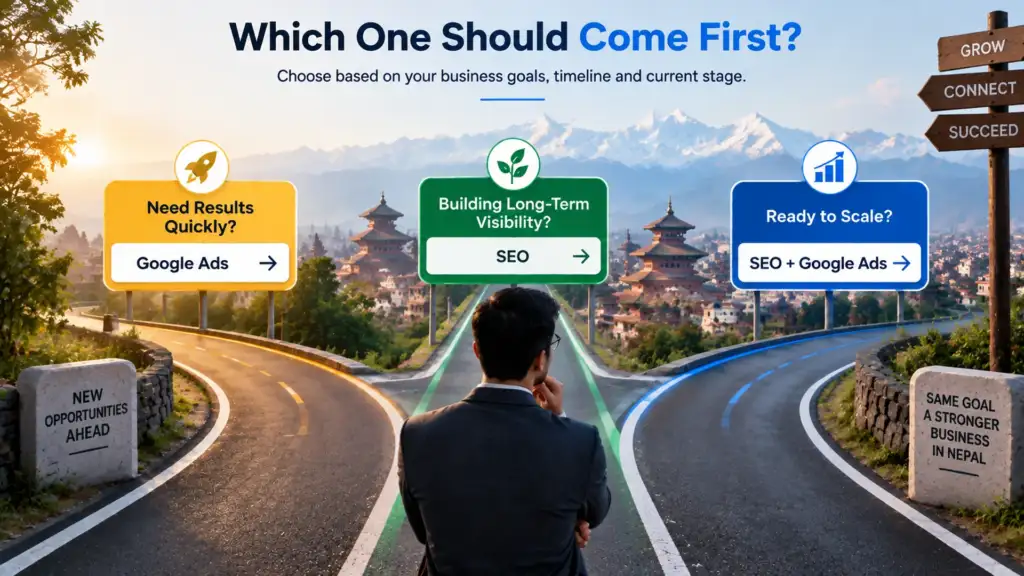
For most Nepali businesses working with a limited budget, the real decision usually isn’t SEO versus Ads it’s which one to start with while building toward the other.
Ads first, then SEO tends to make sense when you need fast validation or immediate revenue, and you plan to use those early results which pages convert, which offers land, which audience responds: to fund and inform an SEO strategy once the offer and audience are proven.
SEO first, then Ads fits businesses with longer sales cycles and lower urgency, where building organic authority first means any later ad spend works harder because it’s landing on a site that already has some established trust, rather than an unknown brand with a paid link at the top of the page.
Both from the start is realistic only when there’s enough budget to do each properly and the conversion basics, a working landing page, tracking, a responsive sales process — are already in place. Running both badly at once is usually worse than doing one channel well, since neither gets the attention it needs to actually perform.
The sequencing decision comes down to how ready the business actually is right now, not preference and it’s worth revisiting every few months as the business changes, rather than answering once and never checking again.
How AI Search Is Changing This Decision
It’s worth acknowledging, carefully, that AI-powered search — Google’s AI Overviews, and AI tools that answer questions directly rather than linking to a list of websites is starting to change how some search behavior works. This is still an early, contested area of SEO discourse, not a settled fact, and it’s worth treating it that way rather than repeating the increasingly common claim that “AI is changing everything” without real evidence behind it.
Many SEO professionals are observing that strong organic visibility and clear, well-structured content may help brands become more discoverable in AI-powered search experiences, although the evidence is still early. If that pattern holds, it’s a mild point in SEO’s favor on the margin — ranking well may increasingly mean being findable by AI systems, not just by human searchers.
This doesn’t change the core decision framework above: timeline, budget, and business readiness still matter more — but it’s worth revisiting as more concrete data becomes available.
Can Nepali Businesses Use Both — and When Does That Actually Make Sense?
For many businesses, using both channels is ultimately the right long-term answer; just not necessarily starting on day one. Google Ads captures demand that already exists right now; SEO builds demand and visibility that compounds for later. Used together with the right sequencing, they cover both the immediate and the long-term side of a business’s growth, rather than forcing a permanent choice between the two.
The practical version of this looks less like running both at full intensity from the start, and more like using one channel’s results to responsibly build toward the other; Ads revenue funding an SEO investment, or SEO traffic reducing how much a business needs to rely on paid clicks over time. If you’re not sure which stage your business is at, that’s exactly the kind of question worth working through directly with a team that runs both channels, rather than one that only sells you the channel it specializes in.
A Quick Way to Check Where You Actually Stand
Before choosing a channel, it helps to answer a few honest questions about your own business, one at a time.
Do you need customers within the next few weeks, or can you wait several months for results to build?
If it’s weeks, that alone points toward Ads first, regardless of what else is true about the business.
Is your website or landing page actually ready to convert the traffic you’re about to send it?
If the honest answer is no, that’s worth fixing before spending on either channel — traffic to a broken page is wasted whether it’s paid or organic.
Do you have a way to track what happens after someone visits your site or clicks your ad?
Without this, neither channel can be judged fairly, and budget decisions end up based on guesswork instead of results.
Is your budget enough to run one channel properly, or would splitting it thin across two channels mean doing both poorly?
A smaller budget focused on one channel usually outperforms the same budget spread across two.
The answers to these usually point toward one channel clearly enough to make the decision easier than it first seemed and if they don’t, that’s a sign the business may need both, sequenced deliberately rather than chosen between.
Frequently Asked Questions
Does running Google Ads affect my SEO rankings at all?
Not directly. Google has confirmed that ad spend doesn’t influence organic rankings; the two systems are separate. What Ads can do indirectly is give you data (which keywords and pages convert) that’s useful for shaping SEO priorities later, and increased brand searches from ad visibility can support organic visibility over time, but there’s no ranking boost from the ad spend itself.
If I start with Google Ads and move to SEO later, do I lose anything in the switch?
No — the two aren’t connected in a way where stopping one damages the other. What you do keep is the market insight Ads generated: which offers converted, which audience responded, which messaging worked. That data makes an SEO strategy that follows more targeted from day one, rather than starting from scratch.
How do I know if my business is actually ready for SEO, or if I need to prepare more first?
A business is usually ready when the basics are already working; a clear offer, a functioning website, and the patience to wait several months before seeing meaningful results. If the offer itself is still unproven, or the website has fundamental issues, it’s often better to fix those first; SEO effort spent on a shaky foundation tends to underperform regardless of how well it’s executed.
Does running Google Ads affect my SEO rankings at all?
Not directly. Google has confirmed that ad spend doesn’t influence organic rankings; the two systems are separate. What Ads can do indirectly is give you data (which keywords and pages convert) that’s useful for shaping SEO priorities later, and increased brand searches from ad visibility can support organic visibility over time, but there’s no ranking boost from the ad spend itself.
If I start with Google Ads and move to SEO later, do I lose anything in the switch?
How do I know if my business is actually ready for SEO, or if I need to prepare more first?
A business is usually ready when the basics are already working; a clear offer, a functioning website, and the patience to wait several months before seeing meaningful results. If the offer itself is still unproven, or the website has fundamental issues, it’s often better to fix those first; SEO effort spent on a shaky foundation tends to underperform regardless of how well it’s executed.
Choosing With Confidence
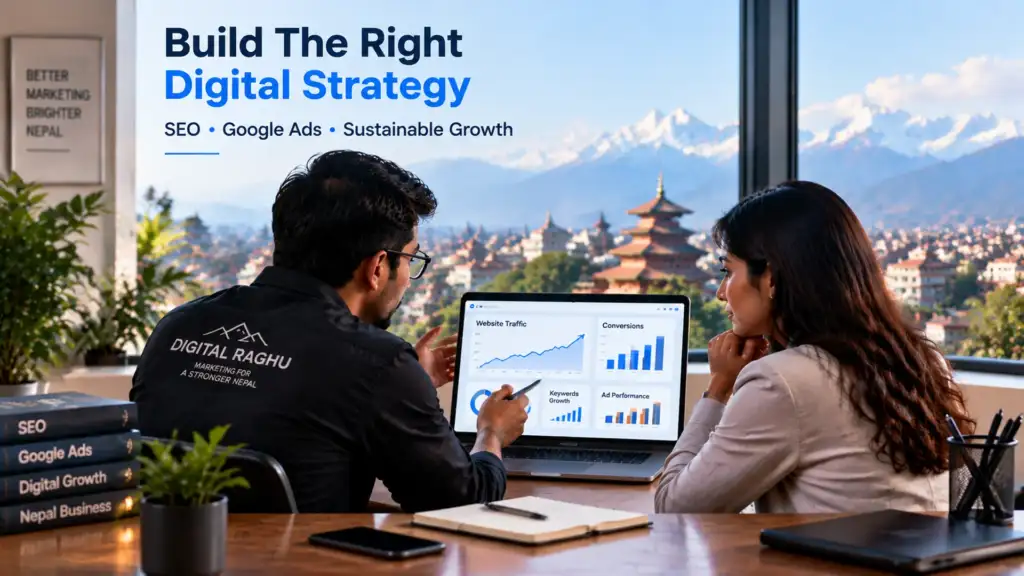
There’s no universal right answer between SEO vs Google Ads; only the right answer for where your business is right now. Businesses that need speed and are still validating demand tend to do better starting with Ads; businesses built on repeat, research-driven, or trust-based demand tend to get more long-term value from SEO. Many end up using both eventually, just not at the same time or in the same proportion from day one.
Digital Raghu can evaluate your current goals, website, and marketing position to recommend whether SEO, Google Ads, or a combination of both makes the most sense through SEO services or Google Ads services.
