

Nepal’s digital economy is growing rapidly. Businesses in Kathmandu and beyond are moving online, and they need skilled SEO professionals to improve their website visibility. Whether you are a fresh graduate exploring career options, a freelancer aiming to earn on Upwork or Fiverr, or a business owner managing your own website, SEO is one of the most valuable hands-on skills you can develop today.
The challenge is that a quick search for SEO training in Nepal shows dozens of options—training centers, freelance coaches, online courses, and institutes. For a beginner, it can be overwhelming to separate valuable training from programs that offer little practical experience.
This checklist helps you tackle that problem effectively. By running any SEO course through these seven checkpoints, you can evaluate whether a program will provide real-world skills, hands-on experience, and knowledge relevant to Nepal’s growing digital market—ensuring your time and investment pay off.
The Checklist: 7 Things to Evaluate Before Enrolling in Any SEO Course in Nepal
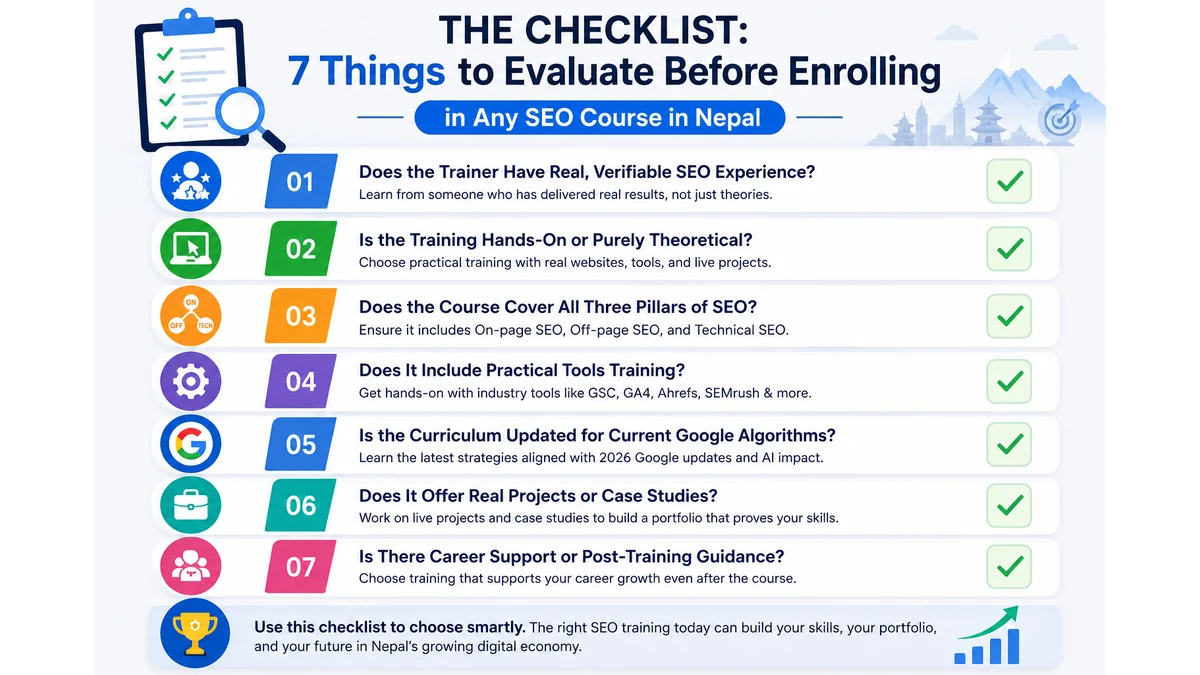
1. Does the Trainer Have Real, Verifiable SEO Experience?
Certifications are easy to collect, but what really matters is whether your trainer has applied SEO in the real world—working on actual websites, improving rankings, and achieving measurable results. A trainer without field experience is like a driving instructor who has never driven on the road: they may explain the rules, but they cannot teach practical skills effectively.
Before joining a course, ask: “Can you show me websites you’ve worked on and the results achieved?” An experienced trainer will illustrate their work with real examples, demonstrating tangible improvements such as increased visitors, better search rankings, or successful project results.
This is not about being difficult—it’s about protecting your investment. The quality of your training depends on the depth of your trainer’s real-world experience. In Nepal’s competitive digital market, a trainer who has hands-on experience ensures you learn SEO skills that are relevant for local businesses, agencies, and freelancing opportunities.
2. Is the Training Hands-On or Purely Theoretical?
SEO is best learned by doing. Watching slides or reading presentations is not enough. Real competence comes from auditing websites, conducting keyword research, analyzing competitors, and using tools like Google Search Console to see how your work affects rankings.
Ask before enrolling: “Will I work on real websites during the course, or is it limited to theory?” This will give you a clear idea of the practical, hands-on experience you can expect from the course.
A strong SEO course in Nepal should put you inside the tools from day one. You should practice keyword mapping, on-page optimization, site audits, and competitor analysis. For example, analyzing a local Kathmandu business website or creating content for a Nepali client will give you experience that is directly applicable after the course.
Hands-on experience sticks with you. It equips you with practical skills that employers, agencies, and clients value—far more than theory alone.
3. Does the Course Cover All Three Pillars of SEO?
SEO has three key pillars: On-page SEO, Off-page SEO, and Technical SEO. A complete course should cover all three, as skipping any area leaves gaps in your skillset.
On-page SEO deals with elements on the website itself—content optimization, meta tags, headings, internal links, and images. Off-page SEO focuses on authority-building outside the site—backlinks, guest posting, and local citations. Technical SEO covers backend factors like site speed, crawlability, indexing, Core Web Vitals, and structured data.
Ask training centers: “Does your curriculum cover on-page, off-page, and technical SEO in depth?” If a course only skims over one of the SEO pillars, it may indicate that the training is incomplete.
Learning SEO that covers all three pillars prepares you to handle real-world challenges in Nepal’s digital market, whether optimizing a local business website, improving a client’s search visibility, or managing freelance projects. A full understanding ensures your skills are practical, relevant, and immediately usable.
4. Does It Include Practical Tools Training?
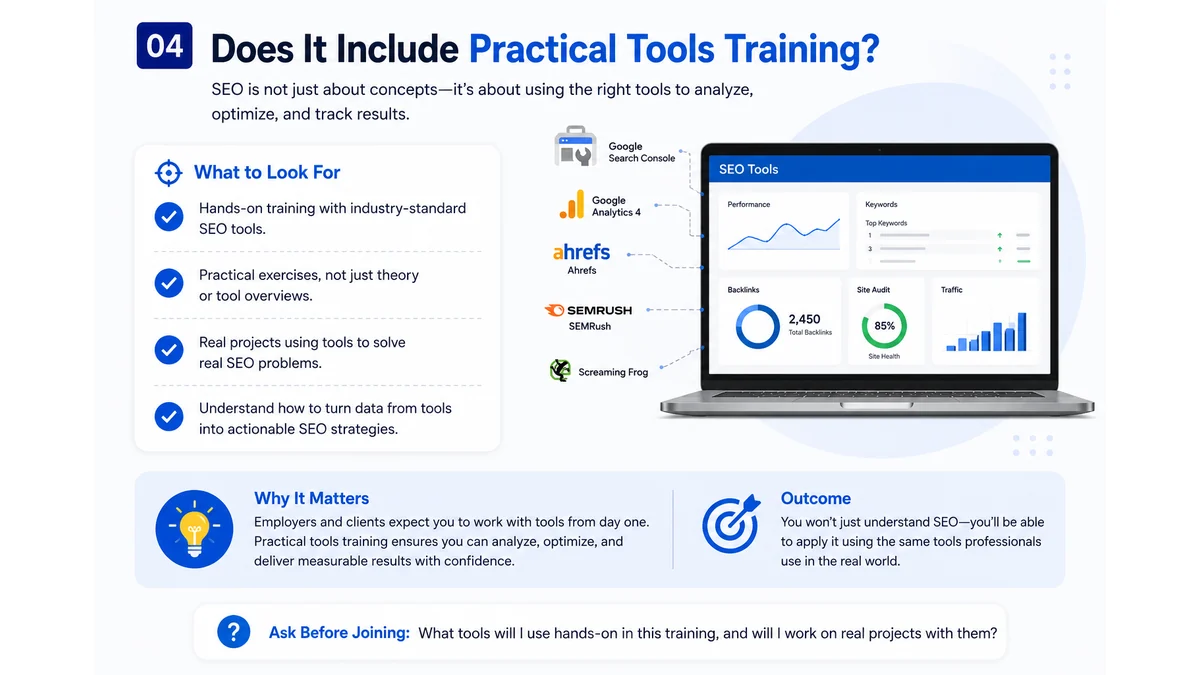
Understanding SEO concepts is one thing—being able to use the tools professionals rely on is another. Employers and clients in Nepal expect you to hit the ground running, which means familiarity with tools like Google Search Console, Google Analytics 4 (GA4), Ahrefs or SEMrush, and Screaming Frog.
Ask before joining: “What software or tools will I use hands-on in this training?” Simply naming SEO tools without giving students practical exercises won’t equip them for professional tasks.
Practical exercises make all the difference. For example, auditing a Kathmandu-based business website, tracking keyword performance, or analyzing a competitor’s backlink profile will give you skills that can immediately be applied to real projects. The goal is to move from understanding theory to producing measurable SEO results, so you can confidently handle client or employer projects right after training.
Hands-on tools experience ensures your SEO skills are actionable, not just conceptual, making you more competitive in Nepal’s growing digital job market.
5. Is the Curriculum Updated for Current Google Algorithms?
SEO is constantly evolving. In 2026, Google’s updates—Helpful Content, EEAT guidelines, and the growing influence of AI—have reshaped what counts as effective SEO. A course teaching outdated methods may not only fail to help you but can also reinforce practices that harm website performance.
Make sure to ask: How recently was the curriculum updated, and does it include AI-powered SEO techniques, Core Web Vitals, and the latest Google algorithm changes? A competent trainer will answer confidently with concrete examples.
For instance, learning how Google evaluates local content for a Kathmandu business or optimizing a Nepali e-commerce site requires knowledge of the latest ranking factors. Updated training prepares you for real-world scenarios that students will encounter in agencies, freelancing, or managing local business websites.
Staying current ensures your learning is relevant, actionable, and aligned with both global SEO best practices and Nepal’s specific digital ecosystem.
6. What Happens After the Course Ends?
Completing a course is just the beginning. The real test is what support you receive afterward. Most SEO training centers in Nepal stop at theory, leaving students without guidance for applying their skills. Good programs offer structured post-course support that bridges the gap between a learner and a professional.
Look for courses that include internship opportunities where you can work on live client projects. Hands-on practice after training helps you gain confidence and credibility. Ask if advanced classes are offered post-completion, whether interview preparation is provided, and if a recognized certificate is awarded.
Digital Raghu’s SEO training program addresses all of these areas. Students gain internship opportunities, hands-on experience with live websites, free advanced classes after course completion, dedicated interview preparation, and a certificate upon finishing. These elements are not just perks—they provide the practical skills and credibility needed to secure your first SEO job or freelance client in Nepal. Post-course support ensures that learning continues beyond the classroom, setting you up for real-world success.
7. Will the Class Size Allow for Individualized Feedback and Guidance?
SEO is a skill that improves most when students receive individualized feedback. Large batches often mean questions go unanswered, feedback is generic, and learning slows down.
Ask: “How many students are in each batch, and will I receive personalized feedback?” Small batches allow trainers to monitor each student’s progress, provide guidance on audits and optimizations, and address mistakes in real time.
Personalized attention is what transforms theoretical knowledge into practical expertise — and in Nepal’s growing digital market, that difference will show up clearly in your results.
Why Learning from an Experienced Trainer Matters
YouTube tutorials and free blogs can teach SEO basics, but they cannot replace learning from someone who has applied these skills professionally for years. The difference lies in context: an experienced trainer explains not just what to do, but why it works, when it might fail, and how to solve real-world problems.
Raghu, the trainer behind Digital Raghu, brings over eight years of hands-on SEO experience and has trained more than 1,000 students across Nepal. Students like Riya Giri and Khushbu Kharga praise his ability to combine theory with practical examples, providing real project exposure in keyword research, on-page optimization, and backlink building.This combination—experienced trainer, practical curriculum, and live project work—ensures that students leave ready to work professionally. You can explore the full Digital Raghu SEO training program here.

Career & Earning Potential After SEO Training in Nepal
Completing a quality SEO course in Nepal opens multiple career paths. In Kathmandu, SEO professionals are finding roles as SEO Specialists, Content Strategists, Digital Marketing Executives, and Technical SEO Analysts. Demand is growing as local businesses increase their online presence.
Freelancing is another strong option. Platforms like Upwork and Fiverr show steady demand for SEO services, and Nepal-based freelancers often enjoy a competitive advantage: good English communication and attractive rates for international clients. Many students secure freelance projects even before finishing the course.
Local opportunities are also expanding. Small and medium businesses—travel agencies, consultancies, e-commerce stores, and restaurants—need SEO support but often lack in-house expertise. A trained SEO professional can step in to provide these services, applying skills learned from hands-on projects, internships, and practical training. With proper guidance, students can turn their learning into real income and career growth.
If you are looking for SEO training in Nepal that covers all the essential skills, explore the full course details and batch schedule at Digital Raghu. The program covers all three pillars of SEO, provides hands-on experience with real tools from day one, and continues support even after the course ends. Students benefit from internships, live client projects, free advanced classes, and interview preparation. To check available batches or enroll, contact the team directly on WhatsApp. They respond quickly and can clarify any questions you have before registration. View the full SEO training program at Digital Raghu.
Frequently Asked Questions (FAQs)
1. How long does an SEO course in Nepal typically take?
Most foundational courses run 30–45 days, while advanced modules may extend further. Digital Raghu’s core program is a 30-day advanced course, covering everything from SEO basics to technical optimization in a focused schedule.
2. How much does SEO training cost in Nepal?
Fees vary by institute, trainer experience, and post-course benefits. Consider what’s included—internships, advanced classes, and a certificate can significantly increase the real value of your investment.
3. Can a complete beginner join SEO training in Nepal?
Yes. Programs like Digital Raghu’s are designed for beginners. No prior technical knowledge is needed—just a willingness to learn and apply.
4. What can I earn as an SEO freelancer in Nepal?
Earnings depend on skill and clients. Intermediate freelancers on Upwork or Fiverr can earn NPR 50,000–150,000 per month once a portfolio is established. Beginners can start with small projects during or after training.
5. Is online SEO training as good as offline training in Nepal?
Both have benefits, but offline courses provide direct interaction with the trainer, immediate feedback on live projects, and structured accountability—especially useful for beginners.
6. Will I get a certificate after completing SEO training?
Reputable centers, including Digital Raghu, provide a certificate to support job applications and freelance profiles.7. How often does Google update its algorithm, and will the course keep me updated?
Google releases thousands of minor updates yearly and several major core updates. A good SEO program teaches students to adapt, not just follow current trends. Digital Raghu’s curriculum is regularly updated for Core Web Vitals, EEAT guidelines, and AI-driven SEO.
