


Yes, you can learn SEO on your own. Beginners can pick up the fundamentals of SEO through free resources, official documentation, and hands-on practice on a real website. What’s harder to build alone is the practical side: applying SEO correctly, fixing technical problems, measuring results, and getting the kind of honest feedback an agency like Digital Raghu gives its clients every day.
This article walks through what you can realistically teach yourself, what tends to trip up self-taught learners, and how to tell if structured guidance would help.
Can SEO Be Self-Taught?
SEO doesn’t require a formal degree or certification to get started. Many SEO professionals begin by studying independently, testing ideas on their own websites, and learning from the results. In that sense, SEO can absolutely be self-taught.
But there’s a difference between understanding SEO and being able to perform SEO work professionally. Reading articles and watching tutorials will teach you the vocabulary and the concepts. They won’t teach you how to diagnose why a specific page isn’t ranking, or how to prioritize fixes on a site with hundreds of pages. That only comes from practising on an actual website, watching what happens, and adjusting your approach.
A pattern that shows up often with beginners: most can explain what a keyword is, but far fewer can explain why they chose one keyword over another for a specific page. That gap between knowing a term and applying it under real conditions is usually where independent study needs the most reinforcement.
So the honest answer is: self-taught SEO knowledge is real and valuable, but it usually needs to be paired with practical application before it becomes a usable skill.
What Can You Learn About SEO on Your Own?
A beginner working independently can realistically cover a lot of ground. Here’s where to focus.
SEO Fundamentals
Start with how search engines work: crawling (how Google discovers pages), indexing (how it stores them), and how results get ranked. You’ll also want a basic grasp of search intent — why someone types a query, and what kind of page satisfies it — along with the three broad categories of SEO: on-page (what you control directly on your own pages), off-page (signals from outside your site, like other websites linking to you), and technical (how easily your site can be crawled and indexed). This article focuses mainly on the first and third, since they’re the most learnable independently — off-page SEO depends heavily on factors outside a solo learner’s control.
Keyword Research
This is where you learn to think like a searcher instead of a writer. Keyword research means identifying relevant terms, understanding roughly how often people search for them, gauging how competitive they are, and recognizing whether a keyword reflects informational intent (“what is”) or commercial intent (“buy” or “hire”). Free tools like Google Keyword Planner are a reasonable starting point.
A useful practice exercise: pick a small local business — a restaurant, a trekking company, or an education consultancy — and try to map out what its potential customers would actually search for. Local search intent works a little differently than broad, global keywords, and understanding that difference early is genuinely useful if you ever plan to do SEO for a Nepal-based business.
On-Page SEO
On-page SEO covers the elements you control directly on a page: titles, meta descriptions, headings, URLs, internal links, and image alt text. It’s one of the more approachable areas for a beginner, since the changes are visible and the logic is easy to follow.
Basic SEO Tools
A few free tools go a long way: Google Search Console (indexing and performance), Google Analytics (traffic and behaviour), Google Keyword Planner (keyword ideas), and PageSpeed Insights (page speed). Learning to read these tools is a skill worth building early.
One habit worth building early alongside them: check whether a page is actually indexed in Search Console before assuming your optimization worked. It’s a common beginner oversight — a page can look perfectly optimized on the surface and still be invisible to Google if it was never indexed in the first place.
None of this requires a paid course. It does require sitting down with each concept and applying it somewhere real, rather than only reading about it.
How to Learn SEO by Yourself, Step by Step
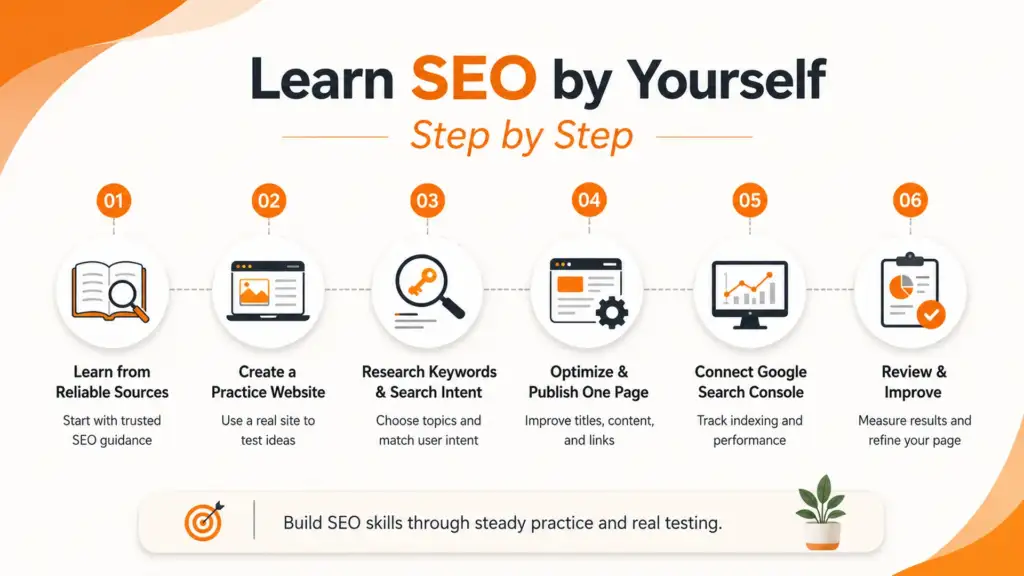
If you’re wondering how to learn SEO by yourself in a way that actually sticks, here’s a practical sequence to follow.
Learn from Reliable Sources
Not all SEO information carries the same weight. Official documentation, like Google’s own SEO Starter Guide, is the closest thing to confirmed guidance. Industry resources and educational blogs are useful for tutorials and interpretation, but treat them as one perspective, not settled fact. Personal testing on your own website is what actually confirms whether a concept applies the way you think it does. Skip the random “SEO hacks” scattered across social media — much of it is outdated or built around tactics Google no longer rewards.
Create or Access a Practice Website
You need somewhere to apply what you’re learning — a personal blog, a portfolio site, or a website built specifically for practice. Without a live site, SEO stays theoretical.
Practise Choosing Pages Based on Search Intent
Once you’re comfortable identifying keywords, the harder skill is deciding what to actually build for them. Take one of the keywords from your research and ask what the searcher expects to find — a quick answer, a comparison, a how-to, or a product. Getting this wrong is one of the most common reasons a well-optimized page still doesn’t perform: the content type doesn’t match what the searcher actually wanted.
Optimize and Publish One Page
Don’t try to overhaul an entire website on your first attempt. Choose one page, apply what you’ve learned about titles, headings, content, and internal linking, and publish it.
Connect Google Search Console
Once your page is live, connect Search Console to see how it’s performing — impressions, clicks, the queries it shows up for, and whether it’s indexed at all.
Review and Improve the Work
SEO isn’t a one-and-done task. Look at what the data tells you, adjust the page, and repeat. This cycle of testing, measuring, and improving is where real SEO skill develops.
Putting the whole sequence together: it helps to know what a finished step actually looks like across all six stages above, rather than just working through the motions.
| Step | What a completed step looks like |
| Keyword research | A list of 10–20 relevant keywords, grouped by intent |
| Page optimization | One page with an updated title, headings, and internal links |
| Search Console | A recorded snapshot of indexing status, impressions, and queries |
| Review | A short note on what you have changed and why you have changed the topic in concern |
Having something concrete at the end of each step also makes it far easier to explain your process later — to a mentor, an employer, or yourself six months from now. If you want a rough pace to work against, this sequence typically spreads across about four weeks for a first attempt: fundamentals and search intent in week one, keyword research in week two, one optimized page published in week three, and Search Console review in week four. It won’t make you a professional SEO in a month, but it gives you a working foundation to build on.
What Makes Learning SEO Alone Difficult?
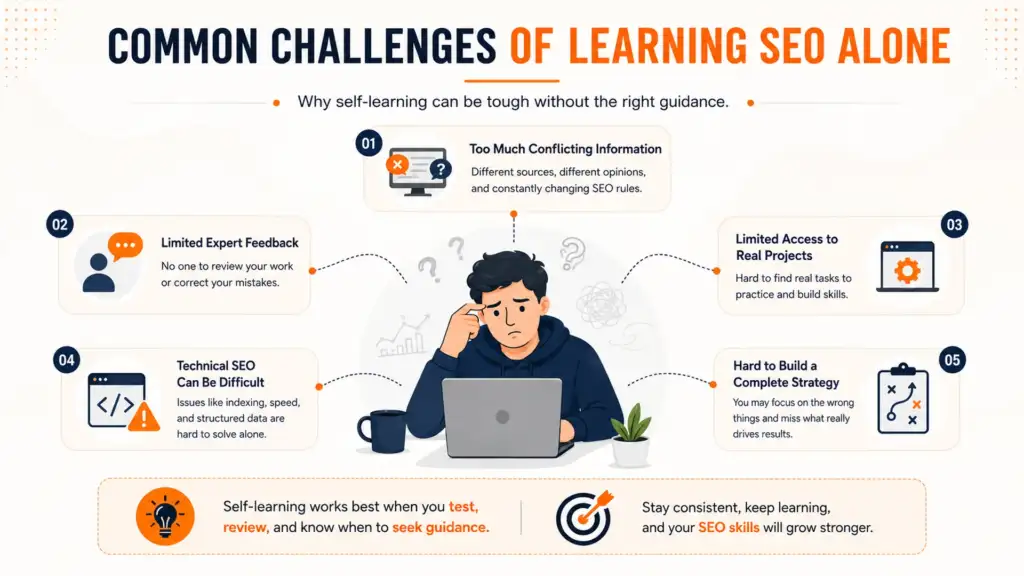
Self-study has real limits worth being honest about.
Conflicting and Outdated Information
Search “SEO tips” and you’ll find advice that contradicts itself — some years out of date, some accurate but written for a very different type of website than yours. Without experience, it’s hard to know which advice actually applies to your situation.
Lack of Expert Feedback
When you optimize a page by yourself, there’s no one to tell you whether your keyword choice made sense, whether your audit missed something important, or whether your fix actually addressed the root problem. You can study SEO independently, but without expert feedback, it may be difficult to know whether your approach is correct or whether important issues have been missed.
Limited Access to Real Projects
A personal blog teaches you a lot, but it won’t expose you to the situations an actual client brings — a local business competing on maps and reviews, an ecommerce site with thousands of pages, or a service business that needs monthly reporting. That variety is hard to replicate alone.
Technical SEO Challenges
Crawling issues, indexing problems, redirects, canonical tags, site speed, and structured data all fall under technical SEO, where a small mistake can undo a lot of good on-page work. It’s usually the hardest area to learn without someone checking your reasoning.
Difficulty Creating a Complete Strategy
You can learn keyword research, on-page optimization, and technical basics as separate skills. Combining them into one coherent strategy — deciding what to prioritize, in what order, and why — is a different skill that usually takes longer to develop without guidance.
This is also where beginners most often confuse finishing tasks with having a strategy. Optimizing five pages is a task list. Knowing which five pages to optimize first, and why those five over the others, is the strategy — and it’s the part self-taught learners tend to skip past without realizing it.
None of this means self-study doesn’t work. Self-study can begin to plateau when learners need feedback, technical troubleshooting, or exposure to more complex websites.
Do You Need an SEO Course to Learn SEO?
No — an SEO course isn’t required to understand the basics. But structured training can help learners who want a clear roadmap, regular feedback, exposure to real projects, some accountability, or preparation for actual SEO jobs and internships.
Structured training typically offers a few things that are hard to replicate alone: a logical learning sequence, a trainer who can review your work and correct mistakes early, exposure to live websites rather than just a personal blog, help with the technical side of SEO, and preparation for internships, interviews, or freelance work. Students preparing for SEO internships are generally in a stronger position when they can demonstrate practical website work rather than relying only on course completion — that’s usually where the gap between self-study and structured practice shows up most.
Beginners who want guided assignments and experience with real websites can explore Digital Raghu’s practical SEO training in Nepal once they’ve decided structured support fits how they want to learn.
Self-Learning SEO vs Structured SEO Training
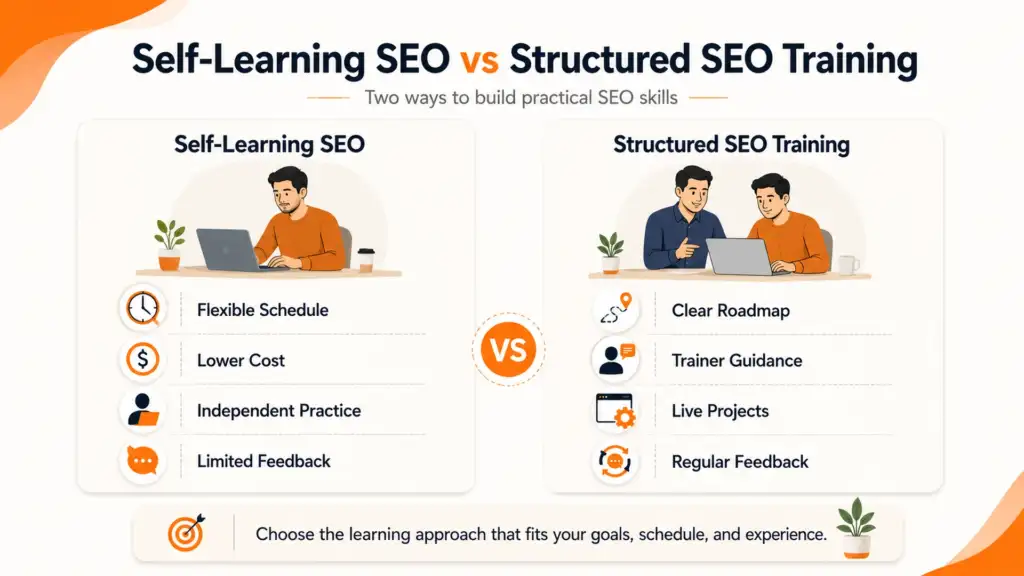
Both paths can work — it depends on what you value and how you learn best.
| Factor | Self-Learning | Structured Training |
| Cost | Free or low-cost | Requires investment |
| Flexibility | Fully on your schedule | Follows a set structure |
| Learning Structure | You build your own path | Organized, sequential |
| Feedback | Limited or none | Direct feedback on your work |
| Practical Experience | Depends on what you set up yourself | Exposure to real/live projects |
| Accountability | Self-driven | Built into the program |
| Career Support | You’re on your own | Internship/interview guidance available |
| Speed of Progress | Often slower past the basics | Can be faster with expert |
Neither option is universally better. The right choice depends on how consistently you can study alone and how quickly you want exposure to real SEO projects.
Who Can Successfully Learn SEO on Their Own?
Self-learning tends to work well for people disciplined enough to keep a consistent schedule, who enjoy testing ideas independently, have access to a website to practise on, and are comfortable learning from mistakes rather than needing quick results.
Who May Benefit More From SEO Training?
Structured training tends to suit complete beginners wanting a clear roadmap, students preparing for internships, career changers building confidence quickly, aspiring freelancers who need real project experience to show clients, and anyone finding technical SEO genuinely difficult alone.
For readers in this group, Digital Raghu’s program is built around helping students learn SEO through real projects rather than theory alone.
How Long Does It Take to Learn SEO all on Your Own?
This deserves its own answer — Digital Raghu has a dedicated article on how long it takes to learn SEO that goes into more detail. In short: the basics can usually be understood within a few weeks, but practical confidence typically takes a few months of consistent, hands-on work, depending on how much time you dedicate and whether you’re practising on a real website or only reading. SEO also isn’t something you finish learning — search systems keep changing, so the learning continues.
Can You Really Learn SEO all on Your Own?
Yes — you can genuinely learn SEO on your own, and many working SEO professionals started exactly that way. The fundamentals are free, and consistent practice on a real website takes you further than reading alone. What’s harder to build without support is feedback on your work, exposure to different types of real projects, and a sense of how all the pieces fit into one strategy.
If you’d rather learn at your own pace and figure things out independently, that’s a completely reasonable path. If you find yourself wanting feedback on your work, exposure to live websites, and guidance through the more technical side of SEO, Digital Raghu’s practical SEO training program is built around exactly those gaps.
Frequently Asked Questions
Can I learn SEO on my own for free?
Yes, to a large extent. Official guides and many educational resources are completely free to your disposal. Some advanced tools and structured programs require payment, but the fundamentals don’t.
Can SEO be self-taught without coding?
Yes. Basic SEO doesn’t require coding. A basic grasp of HTML becomes helpful once you get into technical SEO, but it isn’t a barrier to starting.
Do I need to create a website to learn SEO?
Not strictly, but it will make a significant difference. Applying SEO concepts to a real page teaches you far more than reading about them in isolation.
Is an SEO course necessary to get an SEO job?
Not necessarily. Employers generally care about practical skills and evidence of real work. A course can help you build those pillars of skills systematically, but it isn’t the only path in.
How can I gain practical SEO experience?
Build and optimize a personal website, help a local business or volunteer organization with its SEO, look for internships, or join a training program with real project work.
