

Most beginners can learn the basics of SEO in one to three months with consistent practice, though becoming confident enough to manage strategy independently takes closer to six months to a year. So how long does it take to learn SEO, really? It depends on your starting point, weekly time commitment, and whether you learn through self-study or structured SEO training. Through our SEO training programs, one pattern shows up consistently: the timeline has less to do with natural talent and more to do with how deliberately someone practices. In the sections below, we’ll walk through each stage so you know what progress typically looks like over time.
Is SEO Difficult to Learn?
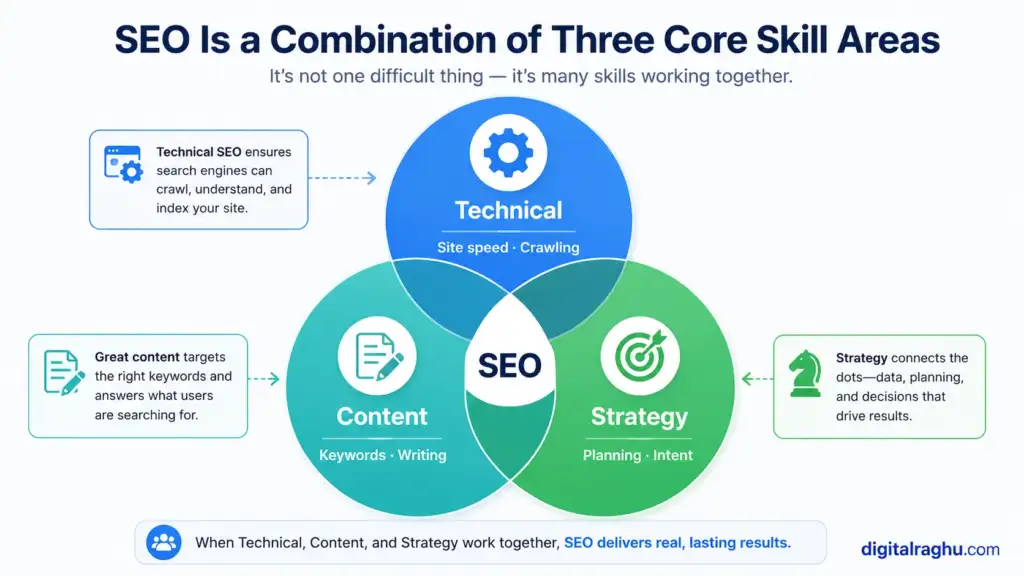
SEO isn’t difficult in the way calculus or coding can be — there’s no complex math or syntax to memorize. What makes it feel challenging at first is that it combines several different skills at once: understanding how search engines work, writing content people actually want to read, and making technical adjustments to a website. For SEO for beginners, the learning curve is steepest in the first few weeks, when terms like crawling, indexing, and backlinks all sound unfamiliar at the same time.
Once the core concepts click, most of SEO becomes pattern recognition. You start noticing why one page ranks and another doesn’t, and the “difficulty” shifts from confusion to simply needing more hands-on practice. A common mistake among beginners isn’t struggling with anything “too technical” — it’s the sheer number of skills competing for attention at the same time, which can make the field feel harder than it actually is. The parts that take longest to master aren’t the beginner concepts — they’re skills like technical audits, competitive analysis, and adapting to algorithm changes, which require experience more than raw learning ability.
So the honest answer is that SEO is easy to start and hard to master. Beginners who expect a short learning curve for the basics are usually right; those expecting the same ease at an advanced level are usually surprised.
What Affects How Long It Takes to Learn SEO?
No two learners follow the same timeline. Although everyone’s learning journey is different, a handful of factors tend to have the greatest influence on how quickly progress happens.
Your Starting Knowledge
If you already understand the basics of how websites work — content management systems, basic HTML, or how Google indexes pages — you’ll move through SEO fundamentals faster. Someone starting completely from scratch isn’t at a disadvantage long-term, but they’ll spend more of the early weeks on foundational concepts before reaching the strategy-level thinking that makes SEO useful.
How Consistently You Study Each Week
This is the single biggest lever. A learner who spends a little time with SEO each day is likely to make steadier progress than someone who studies only once a week. The advantage isn’t simply the number of hours invested; regular practice keeps new concepts fresh, allowing each session to build naturally on the previous one instead of starting from scratch. Consistency compounds — a learner who shows up daily for a month often outpaces someone who studies in scattered bursts over three. Many beginners discover this the hard way: two people with the same total study hours can end up months apart in actual skill, simply because of how those hours were spread out.
Learning by Doing vs. Only Consuming Content
Watching tutorials and reading guides builds vocabulary, but SEO only really sinks in once you apply it to a real website. Someone who sets up a test site, runs an actual keyword search, and watches how a page performs over a few weeks will understand ranking factors faster than someone who has read twice as much without touching a live project. Passive learning explains the “what”; hands-on practice teaches the “why.”
Self-Learning vs. Guided Learning
Self-taught learners have unlimited free resources available, but that abundance creates its own problem: not all advice agrees, and there’s no built-in way to tell a current best practice from outdated information until you’ve wasted time on it. Guided learning trades that abundance for quality control — a mentor or instructor has already filtered out the noise, so the resources you’re working from are more likely to be accurate and current. The tradeoff isn’t really about direction (what to learn first); it’s about trust — knowing that what you’re being taught is correct before you build further knowledge on top of it.
A Realistic SEO Learning Timeline
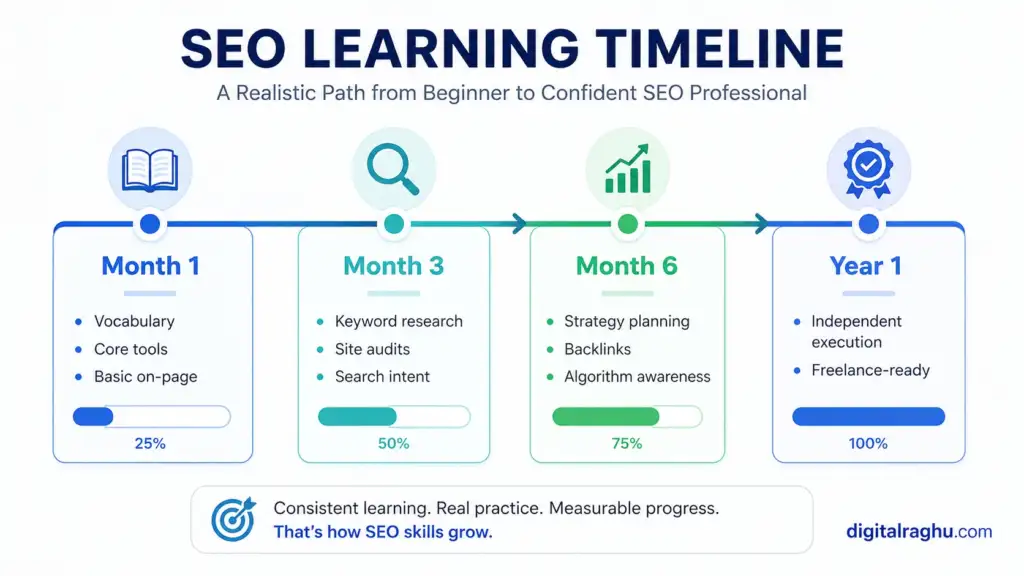
Timelines vary by person, but most learners who study consistently follow a recognizable progression. Here’s what that typically looks like.
What You Can Learn in Your First Month
The first month is about vocabulary and orientation. You’ll learn how search engines crawl and index pages, what keywords are and why they matter, and the basics of on-page elements like title tags, meta descriptions, and headers. Most beginners spend this stage exploring free tools — Google Search Console, Google Analytics, and a keyword research tool — just to see what the data actually looks like rather than trying to act on it yet. By the end of month one, a consistent learner can usually optimize a single page’s title, description, and headings correctly, even if they don’t yet understand why every rule exists.
What You Can Achieve After Three Months
By three months, the pieces start connecting. You move from memorizing individual on-page elements to understanding how they work together — why keyword placement matters alongside content quality, site structure, and page speed. This is usually where search intent, keyword research, and content quality stop feeling like separate topics and start clicking together as one connected process, rather than isolated rules to follow. This is also when learners run their first real keyword research project, mapping search intent to content ideas rather than guessing at what to write.
Technical concepts like site speed, Core Web Vitals, mobile-friendliness, and basic crawl errors start making sense, even if fixing them independently still feels shaky. Three months in, most learners can audit a small website and identify obvious problems, even if they need guidance to prioritize fixes. A recurring pattern at this stage: learners can spot that something is wrong on a page long before they can explain why it’s wrong — that explanatory layer comes a bit later.
What You Can Achieve After Six Months
Six months is typically where confidence catches up to knowledge. Learners at this stage can usually plan a basic SEO strategy for a small website on their own — choosing target keywords, structuring content around search intent, and tracking whether changes actually move rankings. Off-page factors like backlinks and digital PR start entering the picture, along with a better sense of how algorithm updates affect rankings. This is also when the gap between beginners becomes visible: those who’ve been applying their learning to real projects are noticeably ahead of those who’ve only been studying theory.
What You Can Achieve After One Year
At the one-year mark, most consistent learners can manage SEO for a website independently — running audits, building content strategies, and troubleshooting ranking drops without needing to look up every step. This is usually the point where someone could realistically take on freelance SEO work or an entry-level SEO role, since the fundamentals no longer require conscious effort. Mastery, though, is a different milestone. Advanced skills like technical SEO architecture, competitive analysis at scale, and adapting strategy to major algorithm shifts typically take well beyond a year of hands-on experience to develop.
Learning SEO vs. Seeing SEO Results
It’s worth separating two timelines that often get confused: how long it takes to learn SEO, and how long it takes SEO to actually work on a website. These aren’t the same clock. A beginner can understand on-page optimization, technical SEO, and off-page SEO within a few months, yet still see little movement in rankings — not because the learning failed, but because search engines typically take weeks to months to crawl, index, and reward changes on any given site. In practice, this is one of the most common sources of discouragement for new learners: they’ve applied what they know correctly, but the results lag behind their knowledge simply because ranking is a separate process from learning.
What Can Slow Down Your SEO Learning Progress?
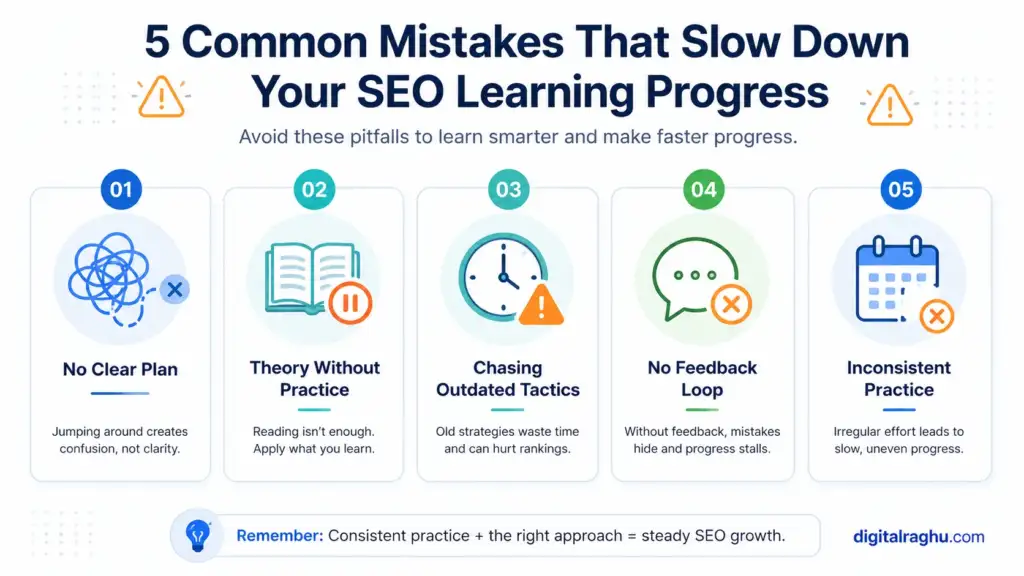
Even motivated learners hit slowdowns. Spotting these habits early makes it much easier to stay on track and avoid spending unnecessary time correcting preventable mistakes later.
Jumping Between Resources Without a Plan
SEO advice is everywhere, but not all of it agrees, and much of it is outdated. Learners who bounce between YouTube videos, blog posts, and forum threads without a clear sequence often end up with fragmented knowledge — they know isolated facts but can’t connect them into a strategy. Without a structured path, it’s easy to spend weeks re-learning the same concept from different sources instead of building on what you already know.
Learning Theory Without Applying It
This shows up as a specific, recognizable stall: someone who can define crawling, indexing, and on-page SEO correctly but freezes the moment they open an actual website’s dashboard, unsure where to start. Months of reading builds vocabulary, not judgment — and judgment (knowing which fix matters most on a specific page) only comes from having made calls on real, messy sites where the “textbook” answer doesn’t always fit. At this stage, many learners understand the concepts in theory but still struggle to apply them with confidence. That gap can feel discouraging, but it’s a normal part of developing practical SEO skills rather than evidence that they’re on the wrong path.
Chasing Outdated Tactics
Search engines continually refine the way they evaluate websites, so SEO best practices evolve over time. Techniques that produced good results in the past may now be ineffective—or even work against a site’s visibility. Learners relying on old guides or outdated courses sometimes waste time perfecting techniques that no longer apply, then have to unlearn and relearn once they discover the information was stale.
No Feedback Loop
Self-taught learners often don’t know if they’re doing something wrong until much later, since there’s no one reviewing their work along the way. Without feedback — whether from a mentor, a course instructor, or a peer community — mistakes can go unnoticed for weeks, slowing progress far more than the mistake itself would have.
Inconsistent Practice
Long gaps between study sessions make it easier to forget what you’ve already learned, forcing you to spend valuable time refreshing old concepts instead of building new ones. Someone who studies for two hours once a week often has to re-orient themselves each time, effectively re-learning the previous session before making new progress.
How to Learn SEO Faster
While there’s no way to skip the learning curve entirely, a few habits consistently help learners progress faster than average.
Practice on a Real Website
Set up a test site or offer to help optimize a small business’s existing website. Applying concepts to a live project — even a low-stakes one — accelerates understanding far more than reading alone. Seeing how a real change affects real rankings makes abstract concepts concrete.
Focus on One Area at a Time
Trying to learn on-page SEO, technical SEO, and link building simultaneously often leads to shallow knowledge across all three. Learners who focus on mastering one area before moving to the next tend to build a stronger foundation, even if it feels slower at first.
Follow a Structured Sequence Instead of Random Resources
Learning SEO from scratch is faster when concepts build on each other in a logical order, rather than jumping between unrelated articles and videos.One effective way to build your skills is to tackle each topic in a logical order. Start by understanding how search engines work, then move into on-page optimization, keyword research and content planning, followed by technical SEO. Leave off-page SEO until the end, when the earlier concepts provide the context needed to make sense of it. Skipping ahead (learning technical SEO before understanding basic keyword targeting, for instance) usually means backtracking later once the gaps become obvious. A structured course typically hands you this order already decided, but even self-taught learners can shortcut a lot of wasted time simply by committing to a sequence like this instead of following whatever topic looks interesting that day.
Get Feedback on Your Work
Whether through a mentor, an instructor, or a community of other learners, having someone review your work catches mistakes early and reinforces good habits before they become hard to unlearn.
Track Your Own Results
Keep a record of what you try and what happens — which keywords you targeted, what you changed, how rankings responded. This turns each project into a feedback loop of its own, even without external guidance.
Conclusion
So, how long does it take to learn SEO? For most beginners, one to three months is enough to grasp the fundamentals, while six months to a year builds the confidence to manage strategy independently. Mastery — the kind that comes from handling algorithm updates, technical audits, and complex campaigns — takes longer and depends more on hands-on experience than time alone.
The fastest route through that timeline isn’t working harder alone; it’s removing the guesswork. Structured learning, real feedback, and a clear sequence can compress months of trial and error into weeks. If you’d rather skip the scattered-resource approach and learn with expert guidance from day one, Digital Raghu’s SEO training program is built around exactly that structure — practical, sequential, and designed to get you from beginner to confident faster than self-study alone.
Reading can build your understanding of SEO, but real expertise develops through consistent application. The more you test ideas, solve real problems, and learn from the results, the more those skills become second nature.
Frequently Asked Questions
Can I learn SEO without coding?
Yes. Most of SEO — keyword research, content strategy, on-page optimization, and off-page SEO — doesn’t require coding. Basic familiarity with HTML helps with technical SEO tasks like fixing crawl errors, but it’s not a prerequisite to start learning.
Can I learn SEO in 30 days?
You can learn the fundamentals in 30 days with focused daily practice — core concepts like keywords, on-page elements, and how crawling and indexing work. Applying that knowledge confidently and independently, though, typically takes longer, closer to the one-to-three-month range.
Which Part of SEO Do Beginners Find Most Challenging?
It’s rarely a specific concept — it’s the feeling of being behind in the first few weeks, when terms like crawling, indexing, and technical audits all sound unfamiliar at once. That feeling is normal and temporary. Most beginners underestimate how quickly it passes once a few core ideas click into place, at which point the rest of SEO starts making noticeably more sense.
How many hours should I study SEO each week?
There’s no fixed number, but consistency matters more than volume. A few focused hours spread across the week, applied to real practice rather than passive reading, tend to produce faster progress than occasional long study sessions.
