


An SEO interview for a fresher in Nepal isn’t always a single formal panel — depending on the employer, it might be one round or a couple, but it usually mixes basic knowledge questions with a short practical task, whether you’re interviewing at a Kathmandu agency, a startup building its own marketing team, or a client project through a freelance platform. Whether you just finished training, are switching careers into digital marketing, or are preparing for your first internship interview, the questions tend to follow a predictable shape: what you know, how you think, and whether you can actually do the work, not just describe it.
This guide from Digital Raghu walks through the questions you’re most likely to be asked, section by section, with what each one is really testing, a sample first-person answer, and where freshers usually lose points.
Basic SEO Interview Questions
1. How would you explain SEO to a client who’s never heard the term before?
What it’s testing: Whether you can explain SEO in plain terms instead of reciting a textbook definition.
Sample answer: “I’d put it simply: two businesses can offer the exact same service, but only one shows up when someone actually searches for it — and closing that visibility gap, without paying for every click through ads, is basically the whole job SEO is doing for them.”
Common mistake: Reciting a dictionary-style definition that could describe any marketing tactic, instead of tying it to something the business itself would actually feel.
2. Walk me through what crawling and indexing actually mean.
What it’s testing: Whether you understand what happens before a page can even rank.
Sample answer: “I’d probably explain it with an analogy — search engines send out bots that act like scouts, following links from page to page to see what’s out there, and that’s crawling. From there, once a bot actually lands on a page, whatever’s on it gets logged and sorted into Google’s system — that part is indexing. Without that second piece happening, a page just won’t turn up in search results, however well it’s put together.”
Common mistake: Treating crawling and indexing as interchangeable, rather than two separate steps a page has to clear.
3. What’s a backlink, and how much weight does it actually carry?
What it’s testing: Understanding of off-page SEO fundamentals.
Sample answer: “I’d compare it to a referral — if a well-known site links over to yours, it’s a bit like a trusted person vouching for you to someone new. Search engines pick up on enough of those as a trust signal, though it’s one factor among several, and quality outweighs quantity by a wide margin.”
Common mistake: Claiming backlinks alone guarantee rankings, without mentioning relevance or the other factors involved.
4. How would you describe search intent to someone new to SEO?
What it’s testing: Whether you understand that ranking well means matching what the searcher actually wants, not just matching keywords.
Sample answer: “Two searches like ‘trekking permits Nepal’ and ‘book Everest trek package’ can look similar on the surface, but the first one’s still gathering information while the second is much closer to booking. Matching a page to that difference is what search intent is really about, not just working the right words into it.”
Common mistake: Reciting the theory around intent correctly, then freezing when asked for an actual example on the spot.
SEO Interview Questions About Your Experience and Approach

1. Why did you choose to learn SEO?
What it’s testing: Genuine interest versus a generic answer picked because it sounded easy or well-paying.
Sample answer: “There’s a gym not far from where I live that spent real money on a decent website, and yet you’d never come across it searching for gyms in that area — seeing that disconnect firsthand is really what drew me toward SEO.”
Common mistake: Answering with something that could apply to literally any career choice, showing no real reflection.
2. Walk me through how you learned SEO, and a project you worked on.
What it’s testing: Whether your training translated into anything hands-on, and whether you can speak to actual tools you’ve used.
Sample answer: “One of the practice projects during training was a mock ecommerce site — I ran keyword research across a set of product pages, adjusted several title tags based on what I found, and later checked their indexing status inside Google Search Console. Small in scope, but it took me through the full loop from research to an actual page change.”
Common mistake: Talking only about the course structure and syllabus, without describing a specific project, page, or task you actually worked on.
3. How do you stay updated with changes to how Google search works?
What it’s testing: Whether you treat SEO as something that needs ongoing learning, not a fixed skill.
Sample answer: “I keep an eye on a couple of trustworthy SEO blogs alongside Google Search Central’s own update notes, and just as importantly, I watch for unexplained shifts in traffic or rankings on sites I’m working on — that’s usually the first real clue something’s changed.”
Common mistake: Claiming to follow “everything” without being able to name a single source or habit.
4. What would you do if a client asked something you didn’t know the answer to?
What it’s testing: Honesty and problem-solving under pressure — a very common fresher-screening question.
Sample answer: “I’d be upfront about not knowing right away rather than risk guessing wrong. Then it’s a matter of actually finding the answer — checking documentation, testing it myself, or asking someone with more experience — before getting back to them with something I’m confident is correct.”
Common mistake: Claiming you’d never face this situation, which reads as either dishonest or inexperienced.
Keyword Research Interview Questions

1. Why does keyword research usually come before anything else?
What it’s testing: Understanding that strategy comes before writing or optimizing.
Sample answer: “It’s about figuring out the actual words and phrases people type in around a topic, before any writing even starts. Doing it first means content gets built around real search behavior instead of a guess at what might match.”
Common mistake: Treating keyword research as a one-time task rather than something that shapes ongoing content decisions.
2. How does search intent affect which keywords you choose?
What it’s testing: Whether keyword selection is grounded in intent, not just search volume.
Sample answer: “Two keywords can sit at roughly the same volume and still be worlds apart in what someone actually wants. On a real estate site, ‘apartments for rent in Lalitpur’ and ‘is renting better than buying in Kathmandu’ read as related, but one visitor wants listings and the other wants a comparison, so each needs its own page built around that difference.”
Common mistake: Picking keywords purely by volume, ignoring whether the content type actually matches what the searcher wants.
3. How does keyword difficulty factor into which terms you’d chase first?
What it’s testing: Realistic thinking about competition, especially relevant for a fresher working on newer or smaller sites.
Sample answer: “It’s a rough measure of how tough it’d be to outrank whoever’s currently sitting at the top for that term. On a newer site especially, I’d rather go after narrower, easier terms early and work up to the harder, broader ones once there’s some authority built.”
Common mistake: Ignoring difficulty entirely and recommending only the highest-volume keywords regardless of competition.
On-Page SEO Interview Questions
1. What’s the real role of a title tag, beyond just naming the page?
What it’s testing: Core on-page fundamentals.
Sample answer: “Most of the time, whatever’s set in that HTML tag is what shows up as the headline on the results page — though Google will sometimes swap in its own wording if it thinks something else fits the query better. In practice, it’s often the single biggest factor in whether someone bothers clicking at all — a perfectly optimized title can still get passed over if it just isn’t compelling to read.”
Common mistake: Only mentioning the ranking impact and ignoring click-through rate.
2. Does the meta description directly affect rankings?
What it’s testing: A commonly misunderstood detail that separates a fresher who’s memorized surface facts from one who understands the reasoning.
Sample answer: “It doesn’t factor into rankings directly, as far as I understand — its real job is nudging someone to click through in the results. A strong one lifts click-through rate, which matters for traffic, even though that’s separate from what the ranking algorithm itself is scoring.”
Common mistake: Confidently stating it directly affects rankings.
3. What’s a sensible way to structure headings on a page?
What it’s testing: Understanding of content hierarchy, not just “use headings.”
Sample answer: “As a best practice, one H1 stating the page’s core topic, H2s breaking out the main sections, and H3s underneath for finer points — it’s more a convention that keeps things scannable than a strict technical rule.”
Common mistake: Saying “use lots of headings” without explaining the actual hierarchy.
4. Why bother with internal linking?
What it’s testing: Whether you understand SEO as a site-wide system, not page-by-page.
Sample answer: “It’s how pages on the same site point to each other. Done well, it guides a visitor toward related content — like a trekking company’s permit guide linking straight to its booking page — and it signals to search engines which pages carry the most weight relative to the rest of the site.”
Common mistake: Describing internal links only as a navigation feature, missing the SEO signal they carry.
5. What makes a URL SEO-friendly?
What it’s testing: Attention to a detail freshers often overlook.
Sample answer: “Ideally short and readable, built from real words that describe the page rather than random parameters or ID numbers, and trimmed down to only what’s necessary.”
Common mistake: Not being able to give a concrete example of a good versus a poor URL.
Technical SEO Interview Questions

1. What does a robots.txt file actually control, and what doesn’t it do?
What it’s testing: Whether you understand the difference between blocking crawling and blocking indexing — a common point of confusion.
Sample answer: “It gives crawlers instructions on which parts of a site they can access — commonly used to keep them away from admin areas or duplicate sections. The nuance worth knowing is that it governs crawling, not indexing directly. A page blocked in robots.txt can still end up indexed if enough external links point to it, so it isn’t a fully reliable way to keep something out of search results.”
Common mistake: Assuming robots.txt guarantees a page won’t be indexed.
2. What’s the actual point of an XML sitemap?
What it’s testing: Understanding of how search engines discover a site’s full structure.
Sample answer: “An XML sitemap is a file that highlights the main URLs a website wants search engines to find. It can make page discovery easier, especially when a website has many pages, a complicated structure, or limited internal links.”
Common mistake: Assuming a sitemap guarantees indexing.
3. What is a canonical tag, and when would you use one?
What it’s testing: Whether you understand duplicate content handling.
Sample answer: “It points search engines to the version of a page that should be treated as the main one whenever near-duplicates exist — say, a Nepal-based online store showing the same product across a few filtered URL variations. The canonical tag consolidates all of that back into one preferred version.”
Common mistake: Being unable to give a real example of when duplicate content actually happens.
4. What’s the difference between a 301 and a 302 redirect?
What it’s testing: A very commonly asked technical question.
Sample answer: “A 301 redirect is intended for a permanent move, and a 302 is intended for a temporary one. Using the wrong one during a site migration sends the wrong signal about whether the change is meant to last, which can cause issues down the line.”
Common mistake: Using them interchangeably, without realizing the choice matters during a site migration.
SEO Practical Interview Questions
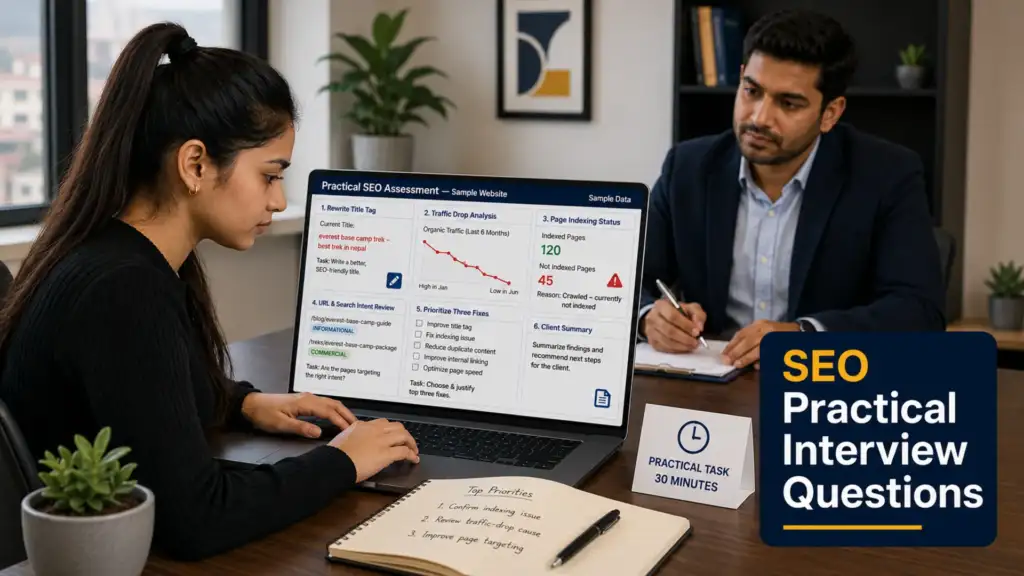
1. “Here’s a title tag: ‘Home | Company.’ What’s wrong with it, and how would you fix it?”
What it’s testing: Whether you can apply on-page knowledge to a flawed real example, not just define terms.
Sample answer: “The title does not tell users what the company offers or which location it serves. That means it misses an important opportunity to describe the page clearly and attract relevant clicks from search results. Something like ‘Affordable Web Design Services in Kathmandu | Company’ would actually tell both Google and the searcher what they’re getting.”
Common mistake: Only saying “it’s too short” without explaining what should replace it.
2. “A client notices a sudden drop in website traffic. What would you investigate first?”
What it’s testing: Prioritization and structured troubleshooting under a realistic pressure scenario.
Sample answer: “Before jumping to conclusions, I’d rule out the ordinary explanations first — a manual action or indexing problem in Search Console, a recent change to the site, and whether the drop hit the whole site or just certain pages. Only after that would I start suspecting a broader algorithm shift.”
Common mistake: Jumping straight to “it must be a Google update” without ruling out simpler, more common causes first.
3. “You’re given access to a client’s Search Console. What would you look at first, and why?”
What it’s testing: Whether you actually know how to use the tool, not just define it.
Sample answer: “I’d open the Performance report first to see current clicks, impressions, and average position, then move to the Page Indexing report to catch anything being excluded that shouldn’t be.”
Common mistake: Mentioning different Search Console reports without showing which one should be reviewed first or explaining how each report helps with the investigation.
4. “What information would you include in a brief monthly SEO report for a client?”
What it’s testing: Whether you can explain SEO performance clearly to a client instead of focusing only on technical data.
Sample answer: “A brief rundown of traffic and ranking changes, what was actually done that month, and what’s coming next — kept simple enough for a non-technical business owner, like someone running a small institute or shop, to follow without needing to interpret raw numbers.”
Common mistake: Describing a report full of technical metrics with no plain-language explanation for the client.
5. “A trekking company’s blog post about a popular route isn’t ranking, even though it’s well-written. What would you check?”
What it’s testing: Whether you can diagnose beyond “just write better content.”
Sample answer: “I would begin by checking whether Google has indexed the article. After that, I would review its keyword targeting, search intent, internal links, page structure, and competition in the search results. A useful article may still struggle to rank when it targets the wrong query or does not match what searchers expect.”
Common mistake: Believing that good writing alone is enough to achieve rankings, while overlooking technical visibility, search intent, keyword selection, internal links, and competing pages.
6. “A training provider has one program focused only on SEO and another covering several digital marketing topics. How should the website organize pages for these courses?”
What it’s testing: Whether you understand search intent and know when different keywords should be assigned to separate pages.
Sample answer: “I would first determine whether people using those two searches expect the same course details and learning outcomes. An SEO course focuses mainly on search engine optimization, while a digital marketing course usually covers several areas. If the search results and user needs are clearly different, I would create separate pages so each one can address its audience more accurately.”
Common mistake: Combining both programs on a single page without first checking whether each search attracts a different audience or requires different course details.
Common Mistakes Freshers Make in SEO Interviews
Beyond the content of the answers themselves, a lot of freshers lose ground on how they come across in the interview:
- Bluffing instead of admitting uncertainty. Saying “I don’t know, but here’s how I’d find out” almost always lands better than guessing and getting it visibly wrong.
- Badmouthing a past trainer, internship, or previous workplace when asked about a difficult experience — even when the frustration is understandable, it reads as a red flag.
- Answering a scenario question immediately, without asking a clarifying question first. Real SEO work involves asking questions before acting; jumping straight to an answer can look like guessing rather than thinking.
- Reciting a memorized definition instead of speaking naturally, even when the underlying knowledge is correct.
- Not asking the interviewer anything at the end. Even one thoughtful question back signals real interest in the role, not just in getting hired.
Conclusion
Freshers often treat SEO interviews like a memory test, but most of these questions are really checking whether the fundamentals have actually sunk in, not just whether they can be repeated on command. Honest, structured answers backed by a real example will generally hold up better than a memorized definition, and the practical questions especially tend to favor people who’ve worked hands-on with an actual website. If you’re still building that hands-on foundation, Digital Raghu’s SEO training is structured around practical, project-based learning rather than theory alone.
